 Despite progress, persistent disparities prolong HIV epidemic among African Americans
New CDC reports illustrates disparities in HIV care.
From Blackaids.org
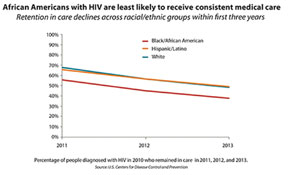
African Americans living with HIV are less likely than white or Latino Americans to receive consistent, ongoing medical care, according to a new Centers for Disease Control and Prevention (CDC) report published last week in Morbidity and Mortality Weekly Report (MMWR). Despite the promising sign of declining HIV diagnoses over the past decade, these findings demonstrate yet another persistent disparity that prolongs the epidemic among African Americans.
Only 38 percent of African Americans got consistent HIV care from 2011 – 2013, compared with about half of whites and Latinos, according to the report. Additionally, African American males were less likely to receive consistent medical care than African American females (35 percent and 44 percent, respectively). Among African Americans, receiving consistent HIV care was highest among those whose HIV infections were attributable to heterosexual contact. Those who got consistent HIV medical care for three years were considered consistently retained in care.
People living with HIV who receive ongoing care and treatment not only remain healthier than those who do not, they al-so dramatically reduce their risk of transmitting the virus to others. According to a separate CDC report published last year and recently updated, it is likely that at least 90 percent of HIV transmission currently comes from people with diagnosed infection who are not retained in care (69 percent) and people whose infection has not been diagnosed (23 percent).
“Consistent care matters. It enables people with HIV to live longer, healthier lives, and it prevents new infections,” said Jonathan Mermin, M.D., director of CDC’s National Center for HIV/AIDS, Viral Hepatitis, STD, and TB Prevention. “And closing this gap in care will be essential if we are to see the narrowing racial divide in HIV diagnoses close completely.”
African Americans Remain Most Disproportionately Affected by HIV
Roughly 1.2 million people in the United States are living with HIV, and about 40,000 diagnoses occur each year, according to the most recent CDC data.
But there are signs of progress. Annual HIV diagnoses declined 19 percent from 2005 to 2014. The largest decreases occurred among African American women, with a 42 percent decline since 2005 and a 25 percent decline in the most recent five-year period. And although diagnoses among Black men who have sex with men (MSM) increased 22 percent over the decade, they have stabilized in recent years.
Still, African Americans more than any other racial or ethnic group continue to be disproportionately affected by HIV. African Americans represent 12 percent of the U.S. population but accounted for almost 50 percent of HIV diagnoses in 2014.
“CDC has been working for many years to eliminate the HIV disparities that exist within the Black community,” said Eugene McCray, M.D., director of CDC’s Division of HIV/AIDS Prevention. “While we are seeing signs of success, we must continue our focus on prevention strategies that will have the greatest impact on African American communities and the nation overall. A key area of focus is ensuring that people living with HIV are diagnosed early, quickly linked to care and receive consistent care that improves their lives and protects the health of their partners.”
Ongoing CDC Efforts
CDC and its partners are pursuing a high-impact prevention approach that advances the goals of the National HIV/AIDS Strategy and maximizes highly effective, scalable HIV prevention methods. CDC provides targeted support to organizations across the country to prevent HIV – and to ensure African Americans who are diagnosed with HIV are promptly connected to ongoing medical care. Activities include:
- Developing new strategies that leverage HIV surveillance data and other in-formation to link and re-engage people in HIV care.
Funding to CBOs and state health departments to provide effective HIV prevention services to gay, bisexual, and transgender youth of color and their partners – including HIV treatment as prevention (TasP) and pre-exposure prophylaxis (PrEP).
- A new project announced in July that will provide up to $216 million over five years to 90 CBOs nationwide to deliver effective HIV prevention strategies to those at greatest risk, including people of color.
- A new project announced in March that will provide up to $60.5 million over four years from the Department of Health and Human Services Secretary’s Minority AIDS Initiative Fund (SMAIF), which supports innovative approaches to addressing HIV in minority communities, to help intensify prevention efforts specifically for MSM of color.
- The Care and Prevention in the United States (CAPUS) Demonstration Project that supports increased testing and optimizes linkage to, retention in, and re-engagement with care and prevention services for newly diagnosed and previously diagnosed racial and ethnic minorities with HIV.
Reducing HIV-related disparities and health inequities – including the expansion of services to black women and young black gay and bisexual men – is one of four goals outlined in the July 2015 Update to the National HIV/AIDS Prevention Strategy.
Other goals are:
- Reducing new infections;
- Increasing access to care and improving health outcomes for people living with HIV; and
- Achieving a more coordinated national response to the epidemic.
CDC works 24/7 protecting America’s health, safety and security. Whether diseases start at home or abroad, are curable or preventable, chronic or acute, stem from human error or deliberate attack, CDC is committed to respond to America’s most pressing health challenges.