 Remembering history and Black public health champions during National Minority Health Month
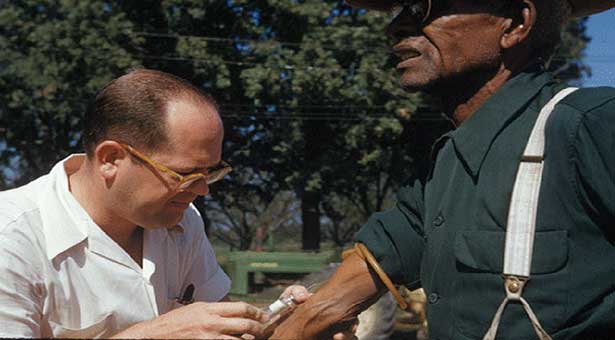
Doctor injects subject with placebo as part of the Tuskegee Syphilis Study.
(Photo by National Archives and Records Administration)
In April of 1915, Booker T. Washington proposed “National Negro Health Week,” recognizing that “without health and long life, all else fails.” His idea gradually evolved into observing the month of April as National Minority Health Month to raise awareness and eventually help eliminate the health disparities facing racial and ethnic minorities.
National Minority Health Month offers a platform to call attention to the deep injustices experienced by people of color and an opportunity to highlight the accomplishments of Black public health champions who have worked to protect and advance the health of marginalized communities.
If we trace history, it’s clear that the medical profession didn’t think the Hippocratic Oath Primum non nocere, or “first, do no harm,” applied to citizens of color. The glaring truth is that science does not operate in isolation from systems of deeply rooted racism and oppression that plague scientific, political, and cultural institutions in the United States—particularly when it comes to health. Such systems have been used to justify unfathomably cruel and inhumane medical experimentation performed on enslaved Black people, which were only replaced in the Jim Crow era by pervasive medical mistreatment that resulted in untold fatalities.
Racist medical practices were tolerated, if not explicitly condoned, by professional organizations such as the American Medical Association through the late 1960s. The government-funded Tuskegee Syphilis Study, which effectively denied syphilis treatment to nearly 400 Black men over the course of 40 years ended in 1972, but a formal apology was not issued for this deliberate violation of human rights until 1997.
And still, in doctors’ offices and hospital rooms across the United States today, race remains a significant predictor of the quality of healthcare a person will receive.
But perhaps just as troubling as the underpinnings of racism in science and medicine is the relative obscurity of racism in the historical narratives propagated by dominant white culture. That modern medicine was built on the backs of marginalized populations is well understood and indeed has been lived by many, but it is far from being accepted as universal truth. Meanwhile, the contributions of Black scientists, doctors, and health advocates have routinely been eclipsed by those of their white colleagues or are absent entirely from historical records.
These advocates range from high-profile figures like Dr. Regina Benjamin, the 18th U.S. Surgeon General who shifted the national focus on health from a treatment-based to a prevention-based perspective, to grassroots activists like Detroit’s Malik Yakini, who in 2006 founded the Detroit Black Community Food Security Net-work to ensure that Detroit communities could exercise sovereignty and self-determiation in producing and consuming affordable, nutritious, and culturally appropriate food. They include Byllye Avery, who in 1974 established the Gainesville Women’s Health Center to expand critical access to abortions and other health care services to Black women, and Dr. Camara Jones, former president of the American Public Health Association, who skillfully brought the impact of racism on health and well-being to the forefront of the public health agenda. These figures even include Bobby Seale. Though he may be best remembered as the co-founder of the Black Panther Party, Seale worked to establish a dozen free community health clinics nation-wide and a free breakfast program that grew to serve 20,000 children in 19 cities around the country.
It is imperative that we not only highlight the health disparities experienced by communities of color that have resulted from interlocking structures of oppression, but also recognize the leaders who have stood on the frontlines demanding change. This must not happen only during National Minority Health Month, but continuously. The work of these leaders both underscores a powerful legacy of social and political advocacy among marginalized communities and serves as a powerful reminder of how far America has to go.
Sarah Reinhardt is a food systems and health analyst in the Food and Environment Program at the Union of Concerned Scientists