 Rep. Scott urges parents to stay vigilant on ESSA
Rep. Scott warns about GOP attacks on Obama’s Education Law
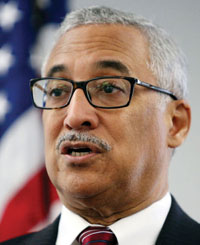
Rep. Bobby Scott said that ESSA presents an opportunity to focus on equity in education by working to replace strategies that didn’t work with research-based interventions that do work. (Freddie Allen/AMG/NNPA)
By Stacy M. Brown, (NNPA Newswire Contributor)
There’s no doubt that No Child Left Behind Act (NCLB) had its share of problems, according to Rep. Bobby Scott, a Virginia Democrat who’s the ranking member of the House Committee on Education and the Workforce.
Among those problems, many school districts grouped all disadvantaged students together in a way that could mask underperformance, especially the underperformance of minority students. That was a major concern for Scott, one of the architects of the new Every Student Succeeds Act (ESSA), signed into law by President Barack Obama in 2015.
“I believe that free, public education is a cornerstone of our democracy,” Scott said. “The No Child Left Behind Act recognized that we needed more than just money. We also had to look at results and, more importantly, act to close achievement gaps.”
But the prescription for NCLB missed the mark. It was wrong, said Scott.
“That’s why I worked across the aisle to pass ESSA in 2015,” said Scott. “ESSA keeps NCLB’s focus on achievement and action to close gaps, but recognizes that [communities]—not Congress—know what works in your schools and communities.”
Scott has repeatedly expressed concerns about Republicans “attacking” the law.
Scott also said that he opposes funding public education with property taxes.
“The United States Supreme Court said, when it issued its historic decision in Brown v. Board of Education, that ‘it is doubtful that any child may reasonably be expected to succeed in life if denied the opportunity of an education; such an opportunity is a right, which must be made available to all on equal terms,’” Scott said.
Scott continued: “The United States has historically funded public education with the real estate tax, virtually guaranteeing more resources in wealthy areas and less in low income areas. So, when Congress passed the original Elementary and Secondary Education Act in 1965, the law’s primary goal was to target federal dollars to underserved areas to make up for use of the property tax as a main funding mechanism for public education.”
With the new law, it’s imperative that parents and teachers know and understand the plans that are under ESSA, Scott urged, adding that parents also need to demand access to state plans and have input, especially in communities of color, because, historically, those students have been marginalized.
“You have to have the flexibility to make good decisions, and the flexibility to make not-so-good decisions too,” said Scott. “[ESSA’s] success will depend on states and school districts writing and implementing good, student-centered policies that force hard conversations and necessary refocusing in state capitols and school board meetings.”
Scott said that ESSA presents an opportunity to focus on equity by working to replace strategies that didn’t work—like exclusionary discipline—with research-based interventions that do work, and like the trauma-informed care being implemented district-wide in Petersburg, Va., to close achievement and opportunity gaps.
Under ESSA, states must have goals for improving the educational outcomes for African-Americans and other minority students, but parents and teachers must make sure that the state and school district’s plans share those goals.
“If nobody screams for them to, ‘Hold the phone, wait a second!’ then state plans [that don’t include those goals] could be implemented,” Scott said, adding that the impetus lies with parents and civil rights leaders to pay close attention and to use the power of the press if necessary as leverage.
With the Trump administration’s failure to adequately fund ESSA, Scott and other proponents of the law have expressed their dismay and some anger.
“It is disheartening and alarming to know that all of the great collaborative work accomplished under President Obama and a bipartisan Congress to pass and implement ESSA is now in grave jeopardy,” said Rep. Karen Bass (D-Calif). “The Trump Administration’s roll back of key accountability and school performance regulations, intended to help states better identify and support our most vulnerable student populations, is careless and indifferent to the lives and academic success of our nations’ children.”
Bass continued: “It is particularly devastating to know that special needs and low-income students as well as students of color; those who primarily occupy already disadvantaged and under-resourced school districts, undeniably stand the most to lose under this disruptive and disconnected administration,” Bass said.
Still, Scott said it would be a mistake to determine that ESSA no longer matters.
“Let me be clear, ESSA matters. Getting ESSA right matters,” Scott said. “The choices you’re making—how to use the law’s flexibilities while respecting equity requirements—those choices matter.”
Scott continued: “I challenge all of you to hold your state and federal governments accountable for supporting college and career-ready standards for all students and investing public funds in public schools.”