By Hansi Lo Wang
(Source: NPR)
A federal judge has declined to temporarily block President Trump’s executive order that calls for restricting voting by mail.
The ruling released on May 28 by U.S. District Judge Carl Nichols, a Trump nominee based in Washington, D.C., leaves in place — at least for now — an order that tests the limits of the president’s power under the Constitution. A separate, 2025 executive order on voting was halted by courts.
The latest executive order, issued March 31, calls for the Department of Homeland Security to work with the Social Security Administration to create lists of adult U.S. citizens in each state, and to send those lists to state election officials. It also calls for the U.S. Postal Service — a federal agency that’s independent of a president’s administration — to come up with lists of eligible voters and to only deliver mail-in ballots to people on those lists.
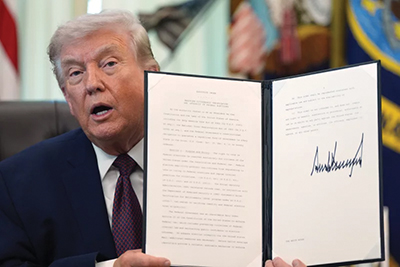
Trump signs a new executive order on voting. Experts say he lacks the authority
Nichols found that it’s too early for a court to issue an emergency ruling that halts key parts of Trump’s order because those directives have not been carried out yet.
“The Court recognizes that the Postal Service may ultimately issue a final rule that directly affects Plaintiffs or their members, or that the Government may develop State Citizenship Lists that omit specific individuals due to particularized flaws. Plaintiffs may, of course, renew their motions if and when those future actions occur. Until then, however, Plaintiffs cannot show that preliminary injunctive relief is warranted,” Nichols wrote about the decision not to block the order.
Nichols’ ruling comes as another federal judge is preparing to issue a decision, as soon as early June, for a similar set of lawsuits based in Boston. A hearing for those cases is scheduled for Tuesday.
The three D.C.-based lawsuits were filed by Democrats and voting rights groups. On Monday, Democrats started the process for appealing Nichols’ ruling.
“Mail-in voting is safe and secure, a hallmark of our free and fair elections. Trump’s order is not about election integrity. It is voter suppression, plain and simple,” Senate Democratic leader Chuck Schumer of New York said in a statement. “Democrats will do everything in our power to ensure that every American can exercise their right to vote.”
Members of Delta Sigma Theta sorority and other marchers gather in Selma, Ala., in 2025 to commemorate the 60th anniversary of the Bloody Sunday march that propelled the passing of the Voting Rights Act.
Why the Supreme Court’s voting rights ruling could play a big role at the local level
Danielle Lang, an attorney at Campaign Legal Center, said the challengers led by the League of United Latin American Citizens “look forward to the next stage of this litigation.”
“Across the country, the administration is attempting to unlawfully shape the electorate to the will of the president and sow doubt in how our elections are run — but we will continue working to stop them at every turn,” Lang added in a statement.
Since Trump signed the order, it’s been unclear whether and how it would actually affect mail-in voting, which has been taking place for state primaries in this year’s midterm election. In early May, the administration said in a court filing that federal agencies were still deliberating how to carry out the order. Acting U.S. Attorney General Todd Blanche later told a Senate Appropriations subcommittee that the Justice Department is working with other agencies to “make sure” the order’s goals are implemented.
Among other directives, Trump called for Postmaster General David Steiner to start a rulemaking process by late May. On May 29, the Postal Service released a Federal Register notice online that included a proposal for creating lists of mail-in and absentee voters based on information from state election officials. The notice says that USPS “would not verify whether individuals should or should not be included” on the lists. It also notes the proposal “would not make changes to the Postal Service’s longstanding Election Mail practices concerning the processing and delivery of ballots that enter the mailstream, including completed ballots mailed by voters to election officials.”
In total, the order’s opponents — which also include almost two dozen states, plus Washington, D.C. — have filed five lawsuits challenging the order.
They argue that Article I of the Constitution gives state legislatures and Congress — not the president — the power to set rules for federal elections. Their lawsuits also contend that Trump’s order directs USPS to make rules about election mail that would overstep the mailing agency’s authority.
Trump, who himself voted by mail in Florida in March, has said he issued the order to stop illegal voting by noncitizens in federal elections, which reviews and research have found to be incredibly rare. While there are voters across the partisan divide who rely on mail-in voting, more registered Democrats than Republicans say they voted by mail in the last national election in 2024.