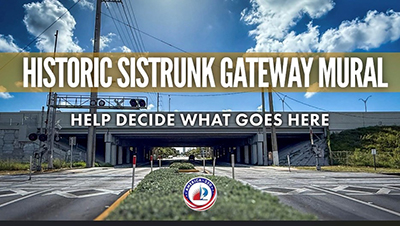
SISTRUNK’S STORY MUST BE TOLD BY THE COMMUNITY
By Westside Gazette Staff
FORT LAUDERDALE, FL — Every community has a story. But when that story belongs to generations of people who built, struggled, sacrificed and persevered, deciding how that history is represented becomes more than an artistic exercise.
It becomes a matter of ownership.
That is why the planned gateway mural at Sistrunk Boulevard and the I-95 overpass deserves the attention—and participation—of the entire Sistrunk community.
The City of Fort Lauderdale has created an opportunity to transform a highly visible gateway into something meaningful: a public reminder of the people, institutions, businesses, traditions and struggles that helped build Fort Lauderdale’s historic Black corridor.
But the community should not simply be asked to approve a finished vision.
It should help create the vision.
Who Gets to Tell the Story?
For generations, Sistrunk has represented much more than a street.
It represents Black Fort Lauderdale.
It represents families who established roots when opportunities were limited. It represents entrepreneurs who created businesses when discrimination restricted where Black residents could shop, work and invest. It represents churches, physicians, educators, civic leaders, entertainers and community organizations that became institutions.
And it represents people whose names may never have appeared in history books but whose contributions made the community what it is today.
The boulevard itself carries the name of Dr. James F. Sistrunk, a pioneering Black physician whose work helped advance the health and well-being of Fort Lauderdale’s African American community.
That history matters.
So do the stories of the people who came after him.
A mural honoring Sistrunk should therefore be more than a collection of attractive images selected because they look good on a wall. It should reflect the lived experience of the community.
That means asking the people who know that history:
Who belongs?
Who should never be forgotten?
Which businesses shaped the corridor?
Which churches served as gathering places and centers of strength?
Which educators, doctors, entrepreneurs, artists, activists and civic leaders opened doors for others?
Which moments of struggle and achievement helped define Sistrunk?
And what does the community want future generations to understand?
Memory Is Not Neutral
There is an important truth about public memorials: what gets remembered—and what gets left out—matters.
A mural becomes part of the public record.
A child passing beneath it may assume that the people depicted were the most important people in Sistrunk’s history. A visitor may look at it and form an immediate impression of what the corridor represents. Decades from now, someone may photograph that wall and regard it as a snapshot of how Fort Lauderdale understood its Black history at this moment.
That is why representation cannot be an afterthought.
If a historic business was central to the community, people who remember it should have the opportunity to say so.
If a neighborhood institution served generations of residents, its story should not disappear simply because it is no longer operating.
If an individual made extraordinary contributions but never received widespread
recognition, this may be an opportunity to correct that omission.
And if longtime residents have memories that do not appear in official archives, those memories deserve to be heard.
History does not live exclusively in government records.
It lives in family photographs.
It lives in church programs.
It lives in old storefronts and neighborhood landmarks.
It lives in stories told at kitchen tables and family reunions
It lives in the memories of elders who watched Sistrunk change over decades.
Those voices are historical evidence, too.
The Community Should Be More Than a Consultant
Community engagement should mean more than asking residents for general opinions after the major decisions have already been made.
It should mean creating a genuine process through which community knowledge can influence what ultimately appears on the wall.
That requires listening before designing—not simply explaining after designing.
The survey being offered by the City is therefore important. Residents, business owners, historians, longtime families, young people and others connected to Sistrunk should take advantage of it.
But participation should not stop with completing a questionnaire.
Community organizations, churches, schools, civic leaders, historians and neighborhood advocates should encourage people to share photographs, names, stories and historical
information that can help build a fuller picture of Sistrunk.
There should be room for disagreement, too.
No single person or organization owns the entire story.
Sistrunk is a collective story.
Honor the Past. Don’t Freeze the Community in the Past.
There is another challenge.
A mural celebrating Sistrunk should not portray the community as though its history ended
decades ago.
Yes, we should remember the people who built the corridor.
But we should also recognize the people building it today.
Black-owned businesses operating today are part of Sistrunk’s story.
Young entrepreneurs are part of the story.
Artists and cultural leaders are part of the story.
Families raising children in the community are part of the story.
The future being imagined by today’s residents is part of the story.
The mural should therefore do more than look backward.
It should create a conversation between generations.
A young person should be able to look at it and see where they came from—and perhaps imagine where they can go.
Development Must Not Become Erasure
Fort Lauderdale is experiencing tremendous growth and change.
Investment can bring opportunity. Redevelopment can bring new businesses, infrastructure and resources.
But development without historical preservation can produce a troubling outcome: a neighborhood remains geographically identifiable while the culture and memory that gave it meaning gradually disappear.
That cannot be the price of progress.
Preserving Sistrunk’s history does not mean opposing the future.
It means insisting that the future have a relationship with the past.
The gateway mural can be one small but highly visible part of that effort.
What Should the Wall Say?
Ultimately, this is not simply a question for artists.
It is a question for the community.
When people enter Sistrunk, what should they see?
Strength?
Resilience?
Entrepreneurship?
Faith?
Culture?
Black excellence?
Struggle?
Progress?
Hope?
Perhaps the answer is all of the above.
But the answer should come from the people whose families and communities gave Sistrunk its meaning.
The wall should not simply tell visitors what Sistrunk was.
It should communicate what Sistrunk means.
And perhaps most importantly, it should say something about what Sistrunk can become.
Speak Up Before the Paint Goes On
The opportunity is here.
Residents and supporters should participate in the City of Fort Lauderdale’s Sistrunk Gateway Mural Survey. Share the name of someone whose contributions deserve recognition. Identify a historic business or institution. Recommend a symbol or cultural tradition. Tell a story that should not be lost.
And encourage someone else to do the same.
Because once the mural is painted, it will become part of Fort Lauderdale’s landscape—and part of the visual record future generations inherit.
We should make sure that record is worthy of the community.
Sistrunk has never been just a boulevard.
It is a legacy.
It is a living community.
It is a story built by generations of Black Fort Lauderdale residents.
And when that story is placed on a public wall for everyone to see, the people who lived it should have a meaningful voice in how it is told.
The question is not simply what should be painted on the wall.
The question is: What do we want the wall to say about us?
ftlcity.info/sistrunkmuralsurvey