
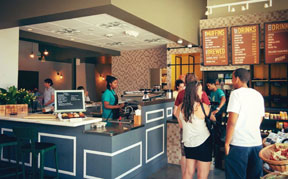
 Black businesses adjust to gentrification in Shaw
By Victoria Jones
Howard University News Service
WASHINGTON, DC – On a hot Friday morning, Uprising Muffin Company, the new Black-owned coffee shop on Seventh Street next to the Shaw Howard Metro stop, is humming. The store, structured on the Starbucks model but with muffins at its core, is doing a brisk business as Shaw residents wander in with laptops and commuters from the nearby Metro station stop in. Business is good.
One block north on the corner of Georgia and Florida avenues, however, things aren’t going so well. Central Communications, a neighborhood staple for 18 years, is barely holding on. Sales are down by about 80 percent, one employee said, and the store’s cell phone sales, primarily pay-as-you-go brands, have not taken off.
This, these days, is the story of gentrification in the once heavily Black Shaw neighborhood. Shaw is a microcosm of Washington neighborhoods in the once “Chocolate City” as upscale whites and other nationalities have flooded the city in recent years.
The changes have been good and bad for Black residents and businesses.
In the Shaw neighborhood, for example, the white population increased from 7.9 percent in 2000 to 33.1 percent in 2010, according to the U.S. Census.
During the same time span, census figures show, the median household income in the neighborhood has gone from $25,000 to $71,000. In 2014, it was $83,000, In 2000, the residents with a bachelor’s degree or higher was 20 percent. It is now 58 percent.
Longtime Black homeowners have benefited greatly as houses they bought in the ‘40s have increased in value 10-fold. Black renters, on the other hand, have been pushed out by dramatically rising housing prices.
While some businesses are struggling, others are seeing some of their best pay days ever.
Lee’s Flower and Card Shop on U Street near 11th Street is one. Owner Stacy Banks, said she has seen profits double over the past five years.
“[Gentrification] has brought more business to the U Street area, so it’s increased our business,” Banks said.
Banks said that new residents with more expendable income have an interest and passion for plants, herbs, and flowers, and they want more fresh flowers for their home for dinner parties and dates.
“With new condos and apartments going in the area, people have wanted to adorn those apartments with plants and fresh flowers, and they’re shopping locally,” she said. “I think that people with more means can spend more money.”
Banks’ grandfather bought the family’s building in 1945. Consequently, the company has avoided the escalating rents.
“We always said that if we rented our building, we wouldn’t be here anymore,” she said.
Johnnie Harris, owner of Johnnie’s Florist at the corner of Georgia Avenue and U Street, said he has also seen an increase of business.
“We have clients all over the D.C. metro area, but the new boom in the neighborhood has definitely been a plus,” said Harris who has been in business 20 years told the Howard University News Service in a recent interview. We have profited for there being changes around the area.”
Wanda Henderson, owner of Wanda’s on Seventh, said she has seen her business grow since moving back to her original business spot on Seventh Street in 2014 after moving her business further north on Georgia Avenue NW due to construction.
It has benefited by offering more services to more people and nationalities in the area, and an abundance of old clients and Howard University students coming into the shop, Henderson said. Her son said she is having no problems attracting the young, affluent newcomers to their business.
“We always had a good business before the area changed, so we were catering to people either from the age of one…to tending to their great-grandmother at 101,” she said.
The rising tide, however, hasn’t lifted all boats.
At Central Communications, one long-time employee said the store, most known for the go-go music blaring from inside, may not be around in the next year or two.
“Once upon a time we stayed packed, and now it’s a trickle,” said Gregory McNeill, a long-term employee and a sound engineer for many major go-go bands. “I give it a year, maybe more in my opinion that this will be here.
“All the people that used to buy are no longer in the city. They have moved out or gotten pushed out. It’s a domino effect. “Over 50 percent of the businesses that used to be here are gone. It’s different, way different.”
Part of the problem, he agreed, might be the company’s business model – its heavy dependence on Federico Lindo, owner of Best Cuts Barber Shop since 1991, said expenses have gone up and his customer base and profits keeps going down as Black males move out of the neighborhood.
“The lease continues to go up, and I can’t really raise my prices like I would like to,” Lindo said. “Everything around us is getting expensive.”
Lindo, whose Georgia Avenue business is right across the street from Howard University said while he is getting some new customers, it’s not enough.
“We see a few other race of people supporting us, but not as many as it used to be when we had more Black residents,” he said.
Torrie’s, a once popular diner on Georgia Avenue and V Street across the street from Howard University Hospital, has also been struggling.
“Most of the people that used to patronize it maybe 10 years ago lived in the areas,” manager Lisa Eady said. “They no longer live here, so now it is midday and there is nobody here is the restaurant,” said manager Lisa Eady.
Eady said that business is down about 50 percent from what it is usually is at its busiest. To help bring back some customers to the restaurant, Eady is planning to use social media used by new residents and switching to a menu to appeal to the new population.
“We need to get the word out that we have good food,” she said.
