
 CBC members worry proposed FCC rule could hurt Black media companies
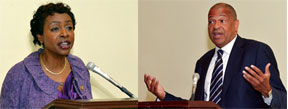
Rep. Yvette Clarke (D-N.Y.) joined Congressional Black Caucus Chair G.K. Butterfield and minority media executives to announce a new Congressional Caucus on Multicultural Media at a recent press conference on Capitol Hill in Washington, D.C. (Freddie Allen/AMG/NNPA)
TV One CEO Al Liggins said that any new FCC rules about set top boxes must protect all of the existing rights and the license agreements involving paid TV providers.(Freddie Allen/AMG/NNPA)
By Lauren Victoria Burke, NNPA News Wire Contributor
In an unpredictable, disruptive media environment featuring new ways for consumers to receive video content over Wi-Fi, apps and live streaming, established media companies are bracing for a future driven by big tech and consumer choice with new profit models.
It happened in the newspaper industry. It happened in the music industry. It happened in the book publishing industry. And now it’s happening slowly but surely in broadcasting as a host of new entrepreneurs is set to arrive on an increasingly competitive scene. In February, Tom Wheeler, the chairman of the Federal Communications Commission (FCC), moved to free consumers, who are now collectively paying $20 billion every year, from buying or renting a set-top box for cable TV. The FCC wants to “unlock the box” and allow others to provide video content such as Google and Apple.
The move would be a shake-up of the status quo. The technology around video-on-demand is clearly changing, as seen in companies such as YouTube, Hulu, TiVo, Kweli.tv, Netflix and Ustream. On April 15, 2016, President Obama signed an executive order backing Wheeler’s efforts to open the cable set top box.
“The cost of cable set-top boxes has risen 185 percent while the cost of computers, televisions and mobile phones has dropped by 90 percent,” Wheeler said on the issue.
Last week on Capitol Hill, Congressional Black Caucus (CBC) Chair G.K. Butterfield and Rep. Yvette Clarke (D-N.Y.) announced a new Congressional Caucus on Multicultural Media that will “focus on the state of diversity and inclusion in the media and in the telecommunications industry.”
Clarke said that the potential harm that the proposed FCC rule could do to multicultural media companies is very real.
She suggested delaying action on the proposed rule, “until the Congressional Research Service (CRS) and the Government Accountability Office (GAO) complete their prospective studies on the impact on multicultural media under this proposed rule.”
Clarke and Butterfield were joined by TV One CEO Al Liggins and BET Networks Executive Debra Lee at the press event announcing the new caucus. Both Clarke and Butterfield serve on the House Energy and Commerce Committee.
“While we must be open to the rising cultural expectations to make programs available on-demand or through streaming services, we also have to balance these interests with the assurance that we are not pitting the few diverse programmers out there against each other or allowing some to pick winners and losers,” Butterfield said.
The phrase, “few diverse programmers” is an understatement. African Americans own less than 1 percent of all TV properties and less than 2 percent of radio as reported by Pew Research.
“We think that the marketplace is robust enough as it is and [the proposed FCC rule] is unnecessary,” said Liggins. “We believe competition should be there, but we believe it should happen in an app form which protects all the rights and the license agreements that we’ve made with the existing paid TV providers.”
Butterfield expressed concerns that the FCC’s plan to “unlock the box” might risk the progress in diverse programming that television audiences have seen in recent years.
Despite that progress, minority-owned media companies represent a minuscule portion of all broadcast media and many Black media company owners are pushing for the FCC change, saying that the status quo has done little to affect the ownership disparity.
On a conference call an hour after Reps. Clarke and Butterfield announced the new caucus, Peggy Dodson, the CEO of the Urban Broadcasting Company offered an alternative view and supported the FCC “unlocking the box.”
“We’re about creating a producing urban content, but that content has to be searchable, it has to be found and it has to be monetized,” Dodson said. “The genie is out of the box. The hourglass has been turned over. I think what is being missed between Comcast and Time Warner fighting with Google and thinking that Google is going to take over, is the minority-owned producers and content creators. We’re being swept under the rug. We need diversity. We do not own anything.”
Dodson continued: “Opening the box is inevitable. It is the answer. It’s happening. We can’t stop it. People are choosing what platforms they want to see programing on and how they want to see it and when they want to see it. Everyone can make money.”
Dodson said that she’s not trying to put TV One or anyone else out of business.
“That is not my goal. My goal is to have the opportunity to monetize and have people see the content on a platform that is searchable and that can be monetized,” Dodson added.
Clifford Franklin, CEO of GFNTV, said that he was shocked to hear the comments from BET and TV One.
“It’s shocking to me to see the comments from BET and TV One because they know this has been a very anti-competitive situation that we’re in. At the end of the day we have to disrupt this industry,” Franklin told reporters.
“We’ve been inundated with baboonery and thugs and anti-social behavior and some of that has come from our urban channels,” Franklin added. “We need a lot more diversity of thought from our content creators. They have pretty much been shut out of the game.”
