By Sam Stockbridge Central Florida Public Media
(Source: Daytona Times)
Thousands of Haitians living in Florida under humanitarian protections could be deported because of a Thursday, June 25 ruling from the U.S. Supreme Court.
Immigration advocates worry that the ruling will tear apart communities that have been living in Florida and the U.S. for more than a decade and cripple industries that have relied on them for years.
The decision centers on the Temporary Protected Status designation, or TPS, a humanitarian protection that the U.S. codified in 1990.
TPS allows vetted immigrants already living in America to remain and work here legally if the U.S. has determined that it would be dangerous to return to their home country. The designation is temporary, often set in six-month increments, but the Secretary of Homeland Security can extend the designations.
The designation has been supported by presidents of both parties since its inception. As of last March, it applied to 17 countries, including Haiti, El Salvador, Ukraine, Syria and other countries, with nearly 600,000 people covered by the designation as of the latest public data from March of 2025.
Immigrants from Haiti make up more than half of TPS holders nationally.
Since President Donald Trump began his second term last year, he has surged immigration enforcement operations nationwide, and on his first day in office he directed his cabinet to limit the scope and length of most of the country’s TPS designations, including Haiti’s. But lower courts blocked him from making those changes.
But in the Supreme Court’s decision Thursday in Mullin v. Doe, the court sided with the Trump administration: Lower courts cannot interfere in the executive branch’s ability to rescind TPS designations.
The court’s decision won’t affect immigrants staying in the U.S. under other programs, according to Anne Piervil, an Orlando immigration attorney, such as those who have become naturalized citizens, hold green cards or are protected asylum seekers from trafficking or violence.
But it could affect more than 158,000 Haitians — and other immigrants — living in Florida under TPS, should the administration choose to begin mass deportations, according to TPS data compiled by the Haitian Bridge Alliance, an immigration nonprofit.
Following the court’s ruling, TPS lapsed for Haitians at the end of the month.
Florida roots
The ruling is particularly meaningful in Florida, which as of 2022 was home to about half of the country’s Haitian population, according to U.S. Census data compiled by the nonpartisan Migration Policy Institute.
Central Florida, at that time, had the fourth-largest Haitian population nationally, with an estimated 41,000 people living here with a green card, TPS or other forms of legal residence.
Haiti has been covered by Temporary Protected Status designation since 2010, when a catastrophic earthquake destroyed national infrastructure. Widespread unrest and crime have wracked the country since 2018.
Many Haitians living in Florida with TPS have been here for more than a decade, according to Piervil, long enough to find careers, start families, buy homes and find a community here.
Piervil herself is Haitian-American. She called the ruling “very shocking.”
“I was born and raised here in Central Florida, but I have family, I have friends, I have colleagues, and they will all be affected,” Piervil said. “I mean, as a community, … we are deeply saddened. … We don’t believe justice was served in this opinion.”
She also expects that deportations would have effects on the hospitality, tourism and health care industries, where Haitians, and Haitian with TPS, make up a large part of the workforce.
“Our medical care — so, from home aid nurses to LPNs to our senior citizen homes — will be greatly affected,” said Piervil. “A lot of medical staff are Haitian TPS holders; also, our educators and our farm workers.”
A ‘death sentence’
The possibility of deportations raises the question of who, exactly, would be responsible for housing.
At the time of the decision, the U.S. Department of State had a travel advisory in place warning against travel to Haiti because of dangerous conditions.
The department designated Haiti with its most severe rating, “Do Not Travel,” citing “the risk of crime, terrorism, kidnapping, unrest, and limited health care.” That’s the same designation it’s given to Ukraine, Iran and Somalia.
Felipe Sousa-Lazaballet conducts informational sessions with immigrant communities as the executive director of the Home CommUnity Center in Apopka. Sending Haitian TPS holders back home would be a “death sentence,” he said. (Sousa-Lazaballet is a Democratic candidate running for a House seat in the Florida Legislature.)
Congressional pushback
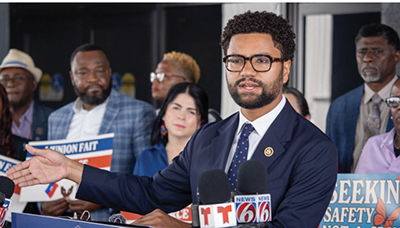
At a press conference on Friday, June 26 in front of The Kingdom Church, a Haitian church in Orlando, U.S. Rep. Maxwell Frost, a Democrat representing Florida’s 10th Congressional District, denounced the decision.
“Temporary [Protected] Status represents one of America’s highest ideals,” Frost said. “It says that when people cannot return home because of war, political instability, humanitarian catastrophe, we offer them temporary protection until it is safe. It is not safe in Haiti. It is not safe in Syria.”
Frost also said enforcing deportations could rip communities and families apart.
“They are scared that they are going to be detained tomorrow, or they feel like maybe they need to self-deport tomorrow, but … they want their kids to continue to go to school here and be here with their friends and their family and the life that they’ve built,” he said. “This is separating families. It will separate families.”
A legislative out
Piervil is holding out hope that federal legislation could avert mass deportations. A bill from the U.S. House, H.R. 1689, would extend Haiti’s TPS designation for three years.
Every Democrat in the House voted for the bill on its final reading in April, and 10 Republicans broke from their party to pass it, including three from Florida:
- Mario Diaz-Balart, 26th district (South Central Florida)
- Maria Elvira Salazar, 27th district (South Miami)
- Carlos A. Gimenez, 28th district (Florida Keys)
The bill awaits further action in the Senate, which is in recess until July 10.