Close Menu
The Westside GazetteThe Westside Gazette
    Facebook X (Twitter) Instagram
    • About Us
    • Contact
    • Media Kit
    • Political Rate Sheet
    • Links
      • NNPA Links
      • Archives
    • SUBMIT YOUR VIDEO
    Facebook X (Twitter) Instagram
    The Westside GazetteThe Westside Gazette
    Advertise With Us
    • Home
    • News
      • National
      • Local
      • International
      • Business
      • Releases
    • Entertainment
      • Photo Gallery
      • Arts
    • Politics
    • OP-ED
      • Opinions
      • Editorials
      • Black History
    • Lifestyle
      • Health
      • HIV/AIDS Supplements
      • Advice
      • Religion
      • Obituaries
    • Sports
      • Local
      • National Sports
    • Podcast and Livestreams
      • Just A Lil Bit
      • Two Minute Warning Series
    The Westside GazetteThe Westside Gazette
    You are at:Home » Federal changes could end up ‘cutting holes’ in HIV safety net, experts say
    Health

    Federal changes could end up ‘cutting holes’ in HIV safety net, experts say

    August 6, 20257 Mins Read41 Views
    Facebook Twitter Pinterest Telegram LinkedIn Tumblr Email Reddit
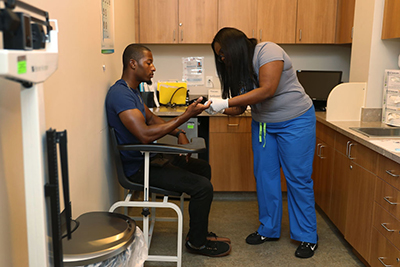
    A patient has blood drawn as he receives a free HIV test from a medical assistant in Miami. The giant tax and spending bill under consideration in the U.S. Senate would bar clinics that provide abortions — which tend to be testing sites for sexually transmitted infections — from accepting Medicaid. (Photo by Joe Raedle/Getty Images)
    Share
    Facebook Twitter LinkedIn Pinterest WhatsApp Email
    Advertisement

    Proposed budget cuts, Medicaid overhaul and delayed grants might threaten progress.

    By: Nada Hassanein

    (Source Stateline)

         TALLAHASSEE, FL — Dallen Michael Greene still remembers the fear he felt when he was diagnosed with HIV in 1999.

    “My heart literally sank to my knees and to my ankles,” he said.

    That fear is what led the 56-year-old resident of Broward County, Florida, to become a mentor and patient guide for the newly diagnosed. He’s a clinical manager at Community Care Resources of Florida, a nonprofit that offers testing for sexually transmitted infections.

    Greene said friends and patients feel some of that same panic and alarm as they worry whether federal action will hinder their access to treatments.

    President Donald Trump’s budget proposal for fiscal year 2026 requests significant reductions to HIV prevention and surveillance programs while preserving other parts of the Ryan White HIV/AIDS Program, the nation’s HIV care and treatment safety net.


    Dallen Michael Greene is a clinical manager at Community Care Resources of Florida. (Photo by Keans Llamera/Courtesy of Dallen Michael Greene)

    Meanwhile, the U.S. Senate is considering Trump’s “big, beautiful bill,” the giant tax and spending plan the U.S. House approved last month. Several of its provisions would affect HIV care, including one that bars clinics that provide abortions — which tend to be testing sites for sexually transmitted infections — from accepting Medicaid.

    The bill also would impose work requirements and more frequent eligibility checks on many Medicaid recipients, potentially interrupting coverage for HIV patients who take medications to suppress the virus, which prevents them from infecting others.

    At the same time, some state health departments say they have yet to receive official notice from the federal Centers for Disease Control and Prevention that their federal HIV/AIDS grants will be renewed. Renewals are for prevention and surveillance grants through May 2026. That’s left county health agencies and nonprofits scrambling for funds to continue HIV/AIDS outreach and testing programs. Some already have laid off staff, including critical disease contact tracers.

    For HIV patients and their health care providers, it all adds up to troubling uncertainty.

    “People are feeling like they’re going to be totally by themselves, and that there’s no resources that are going to be available for them,” Greene said.

    A spokesperson for the U.S. Department of Health and Human Services insisted that HIV/AIDS programs are a high priority for the administration, and will continue under a proposed new agency that would be called the Administration for a Healthy America.

    Living longer

        People with HIV are living longer because of new drug treatments. But annually, the U.S. sees nearly 32,000 new HIV infections. State and public health agencies rely on contact tracing and public education to try to limit new infections. But they are hindered by persistent stigma surrounding HIV, lack of access to care, homophobia and the fact that a disproportionate number of people with HIV are poor.

    Anyone, regardless of sexual orientation, can contract HIV, but Black and Latino men with male partners and Black women and transgender women have disproportionately high infection rates. New infections are more prevalent in the South.

    The operable term is ‘safety net.’ And you’re cutting holes in it. The more holes, the more stuff falls through.

    – Rob Renzi, chief executive officer of Big Bend Cares

    “The operable term is ‘safety net.’ And you’re cutting holes in it. The more holes, the more stuff falls through,” said Rob Renzi, chief executive officer of Big Bend Cares, a Tallahassee-based nonprofit that provides HIV services to the surrounding eight-county area of North Florida’s sprawling rural communities.

    Three dozen North Florida HIV patients rely on housing assistance from the nonprofit, which receives federal funds through Housing Opportunities for Persons With AIDS — one of the initiatives that Trump’s budget proposal would eliminate. Without the funds, those residents could become homeless, Renzi said. Another 17 people housed through a separate federal grant the organization uses for previously incarcerated HIV patients could also lose housing.

    “Taking an HIV pill is down on your list if you have no food or place to sleep,” Renzi said.

    Uncertain grants

    Emily Schreiber, senior director of policy and legislative affairs at the National Alliance of State and Territorial AIDS Directors, said Wednesday the CDC began rolling out the delayed grants. But the uncertainty has already caused damage.

    A woman conducts an STI test.

    Samantha Miears, program manager, conducts an STI test at Coastal Bend Wellness Foundation, a federally qualified health center that provides HIV and community health outreach. (Photo courtesy of Coastal Bend Wellness Foundation)

    Raynard Washington, director of the Mecklenburg County Public Health Department in North Carolina, said his agency laid off six workers — including five contact tracers — after it did not receive a grant renewal notice. Contact tracers ensure a person knows about their positive diagnosis and try to identify the patient’s partners so they can get care and testing, too.

    “The quicker we can close the loop with the contact tracing, can notify partners to get partners tested [and] in treatment, the quicker that we’re able to actually stop transmission from happening in the community,” Washington said. He added that “the more people that we have accessing prevention services like PrEP, the less opportunity we have for new infections.”

    Even if the agency receives a renewal notice, rehiring the workers would be costly, he said.

    Samantha Miears, program manager, conducts an STI test at Coastal Bend Well-ness Foundation, a federally qualified health center that provides HIV and com-munity health outreach. (Photo courtesy of Coastal Bend Wellness Foundation)

    Dr. Thomas Dobbs, dean of population health at the University of Mississippi Medical Center and former state public health officer, said his state’s HIV infection rates have remained steady over the past decade. He worries federal cuts and delays will stall progress — and disproportionately hurt marginalized communities.

    “People in Mississippi don’t have riskier sexual behaviors than people in California,” he said. Rather, “the system has not been adequately designed and resourced and engaged to treat them.” Dobbs described the cuts as “pretty shortsighted.”

    Coastal Bend Wellness Foundation in Corpus Christi, Texas, serves a 12-county area that includes many rural communities, said Chief Executive Officer Bill Hoelscher. He said his group relies on federal funds issued through the state for HIV testing and risk reduction.

    But a letter from the Texas Department of State Health Services, dated May 30, instructed the nonprofit to refrain from incurring costs starting May 31, as the state hadn’t received grant renewal notices from the CDC.

    The renewal period for the next grant cycle begins July 1. Hoelscher applied but hasn’t yet heard back.

    “Usually, we have a renewal in place and we’re ready to go by. But we have not heard from them [the CDC],” he said. “If we don’t hear from them … then July 1, effectively, there will be no more government-funded HIV testing by us.”

    In a June 13 letter to the CDC, Texas state health officials asked for a status update on the grants. But as of Wednesday, the state hadn’t received a response, said spokesperson Lara Anton.

    “We have been writing furiously for emergency funds through other grants, foundations, trying to see if we can get some help to shore it up until we figure out what to do,” Hoelscher said.

    Skipping pills

    In Maryland, many patients participate in a state program that helps pay for HIV medications. The uncertainty about federal money is causing alarm among some patients.

    “We have already received calls like, ‘Hey, should I start skipping pills? Should I start doing every other day? Do I need to build a war chest of medications?’” said Peter DeMartino, director of infectious disease prevention and health services at the Maryland Department of Health.

    The CDC reportedly reinstated several HIV prevention staff that had been part of mass federal layoffs. But DeMartino and health officials in other states say their departments are still missing their federal partners.

    DeMartino said one CDC assignee whose position was eliminated had worked at his office for nearly two decades.

    Back in Broward County, nonprofits and clinics are struggling to keep programs going as they await federal notices.

    “Will there be enough funds?” Greene said. “We’re not sure how much money we’re going to receive or when it’s going to come. So that’s a very scary thing.”

    Back in Broward County nonprofits and clinics are struggling to keep programs going as they await federal notices.
    Share. Facebook Twitter Pinterest LinkedIn Reddit WhatsApp Telegram Email
    Carma Henry

    Carma Lynn Henry Westside Gazette Newspaper 545 N.W. 7th Terrace, Fort Lauderdale, Florida 33311 Office: (954) 525-1489 Fax: (954) 525-1861

    Related Posts

    As state consider changes, new online tool eyes impacts of declining vaccination rates

    October 13, 2026

    Holy Cross Health Receives Emergency Nurses Week Proclamation from City of Deerfield Beach Emergency Nurses Week is October 11 to 17 Caption: Holy Cross Health nurses Lisa Alward, Angi Dionne, Karla Davis and Ian Worley receive an Emergency Nurses Week proclamation from City of Deerfield Beach Mayor Todd Drosky, Vice Mayor Michael Hudak and commissioners Ben Preston, Daniel Shanetzky and Tom Plaut. Photo Credit: Holy Cross Health Submitted by Paige Feigenbaum and Joseph Guastaferro DEERFIELD BEACH, FL– In advance of Emergency Nurses Week, Holy Cross Health received a proclamation from the City of Deerfield Beach at the city’s commission meeting on October 6. Emergency nurses are the first line of defense in the health care system, providing lifesaving care to patients during their most vulnerable moments. This year’s Emergency Nurses Week theme highlights the resilience, expertise and unwavering dedication these professionals bring to local emergency departments every day. “It is an honor for the City of Deerfield Beach commission to invite us to their meeting. This official proclamation means a great deal to our local frontline health care workers by helping raise public awareness of the critical role emergency nurses play in public safety and community health,” said Lisa M. Alward, BSN, RN, TNCC, SANE-A, Unit Base Nursing Council Chair at Holy Cross Freestanding Deerfield Beach Emergency Department. “On behalf of our council and my colleagues, I appreciate the time, leadership and constant support we receive from Mayor Drosky and Vice Mayor Hudak. The commission and Holy Cross Health both provide essential services to our community.” For more than 70 years, Holy Cross Health has been serving Deerfield Beach residents, but never more so than now. In May, the new Holy Cross Health Center & Emergency Care — Deerfield Beach opened to provide care closer to home. Holy Cross Health will fill even more emergency nursing positions when Holy Cross Health Center & Emergency Care – Fort Lauderdale at Sunrise, which is currently under construction, opens in August 2027. This year, Emergency Nurses Week will be celebrated from October 11 to 17 with Emergency Nurses Day on October 14. Emergency nurses care for patients on the worst days of their lives, and Emergency Nurses Week serves as an annual reminder to recognize the dedication, compassion and strength emergency nurses display, even in the most challenging times. Since 1989, the Emergency Nurses Association (ENA) has recognized the second Wednesday in October as Emergency Nurses Day to honor emergency nurses for their commitment to patient care. In 2001, ENA expanded the celebration to devote an entire week to celebrating emergency nurses. For more information on emergency nursing or Emergency Nurses Week, please visit the Emergency Nurses Association at www.ena.org. During Emergency Nurses Week and throughout the year, Holy Cross Health encourages patients and their families to show their appreciation for emergency nurses or any health care provider who goes above and beyond the call of duty and touched their lives by making a monetary gift through the Healing Heroes program, which honors exceptional service and advances Holy Cross Health’s mission of compassionate, patient-centered care. Each Healing Hero receives a special pin and a personal note of gratitude. Donors may contribute any monetary amount they feel comfortable giving and direct their funds to an area of the hospital that means the most to them, including cancer, heart and vascular, orthopedics, neurosciences, Institute for Nursing Excellence, medical equipment and technology, or they can customize their donation. Learn more, make a donation and share a story of gratitude at Holy-Cross.com/HealingHeroes. ABOUT HOLY CROSS HEALTH A member of Trinity Health, Fort Lauderdale-based Holy Cross Hospital, dba Holy Cross Health, is a full-service, not-for-profit, Catholic, teaching hospital operating in the spirit of the Sisters of Mercy for more than 70 years. Holy Cross Health earned High Performing ratings for five Types of Care in U.S. News and World Report’s 2026-2027 Best Hospital rankings; received the American Heart Association’s Commitment to Quality award for achieving high performance across three or more clinical areas in the Get With The Guidelines® program for two years running in 2025 and 2026; received “LGBTQ+ Healthcare Equality High Performer” designation from the Human Rights Campaign Foundation’s 2026 Healthcare Equality Index; and received four out of five stars in the Centers for Medicare & Medicaid Services Overall Hospital Quality Star Ratings for two consecutive years in 2025 and 2026. Additionally, Holy Cross Wound Healing and Hyperbarics program earned the 2025 Center of Distinction award by Healogics®, Physicians Outpatient Surgery Center at Holy Cross HealthPlex landed a spot on Newsweek’s list of America’s Best Ambulatory Surgery Centers 2025 and Holy Cross Health Foundation is designated as a High Performer from the Association for Healthcare Philanthropy. Holy Cross Health was also named among the 2024 America’s Best-In-State Hospitals by Newsweek and selected as a Forbes America’s Best Employers for Healthcare Professionals in 2025 and 2026. Through strategic collaborations and a commitment to being a patient-centered, transformative and healing presence, the 557-bed hospital offers progressive inpatient, outpatient and community outreach services and clinical research trials to serve as the community’s trusted health partner for life. Holy Cross Health also includes the new Holy Cross Health Center & Emergency Care — Deerfield Beach, which opened in May 2026; Holy Cross HealthPlex outpatient facility; The Holy Cross Health Family Health Center in Oakland Park; urgent care centers; and more than 40 Holy Cross Medical Group offices, a multi-specialty physician-employed group of 200+ physicians providing services throughout Broward County. Holy Cross Health Center & Emergency Care – Fort Lauderdale at Sunrise is currently under construction and is expected to open in August 2027. To learn more about Holy Cross Health, visit holy-cross.com, and connect with them on Facebook, LinkedIn, Instagram and YouTube.

    October 13, 2026

    Holy Cross Health is Only South Florida Hospital to Earn the American Heart Association’s Commitment to Quality Award

    October 13, 2026

    (Please enter your Payment methods data on the settings pages.)
    Advertisement

    View Our E-Editon

    Advertisement
    https://youtu.be/5prVj0eWVYg?si=cHOS4Gls9F52Yrk0
    Advertisement

    –>

    Advertisement
    Advertisement
    advertisement

    Advertisement

    –>

    The Westside Gazette
    Facebook X (Twitter) Instagram Pinterest
    © 2026 The Westside Gazette - Site Designed by No Regret Media.

    Type above and press Enter to search. Press Esc to cancel.

    Go to mobile version