By Westside Gazette Staff
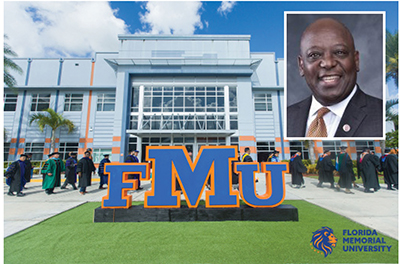
MIAMI GARDENS, Fl — Florida Memorial University President William McCormick is pushing back against a recent report questioning the long-term financial viability of South Florida’s only historically Black university, declaring that FMU will answer its critics not through retaliation, but through measurable results.
McCormick’s comments came in response to an article titled “Florida Memorial University Ranked Among Financially Distressed Colleges at Risk of Collapse,” written by Stephan Rob. The article cites Johns Hopkins educator Dan Yee, who reportedly assessed FMU as being among financially distressed institutions and suggested the university is unlikely to survive another 10 years.
Rather than dismissing concerns about the university’s financial condition, McCormick acknowledged that FMU should be subject to legitimate scrutiny while strongly rejecting the notion that one assessment should define the institution’s future.
In a public address posted on Facebook, McCormick said FMU is entering what he described as a new period of growth, innovation, and institutional transformation.
“The transformation at Florida Memorial University is entering a new era of growth, innovation, and institutional transformation, marked by investments in academic technology, expanding corporate collaborations, renewed campus momentum, and 2026 Fall enrollment numbers projected to challenge a benchmark the university has not reached in more than two decades,” McCormick said.
The president acknowledged that those efforts are taking place at a time when the university can expect questions about its finances, operations, and long-term sustainability.
“FMU’s progress comes during a period in which we know we will face external scrutiny and critical media coverage,” he said. “For me, I get it and I will not hide from responsible scrutiny, accountability, or legitimate inquiries. Moreover, our future cannot and will not be reduced to a single opinionated article, headline, or outside negative intended narrative.”
McCormick also emphasized his respect for the role of journalism and the responsibility of institutions to answer legitimate questions.
“I respect the role of a free and independent press, but strong institutions should never fear examination which we don’t,” McCormick said. “Trust me when legitimate concerns are raised. We examine them.”
At the same time, McCormick drew a distinction between responding to legitimate concerns and allowing outside criticism to determine the university’s direction.
“There’s a clear section between accountability and allowing criticism to dictate the university path forward as we will not be governed by headlines,” he said. “Our response to negativity will not be retaliation. Our response will be results!”
A Critical Moment for South Florida’s HBCU
The questions surrounding FMU carry significance beyond the future of a single university.
Founded in 1879, Florida Memorial University has played an important role in the educational, cultural, and economic development of Florida’s Black community. Its position as South Florida’s HBCU gives the discussion about its financial health particular importance for alumni, students, faculty, donors, business leaders, and the broader community.
The competing narratives now place increased attention on measurable indicators of FMU’s progress.
McCormick points to investments in academic technology, growing corporate partnerships, renewed activity on campus and projected Fall 2026 enrollment as evidence that the university is moving in a positive direction. The critical report, however, raises a larger question that FMU and its leadership will likely continue to face, whether that momentum can translate into the long-term financial stability necessary to sustain the institution.
For the Black community, the answer matters.
Historically Black colleges and universities have survived generations of unequal funding, limited access to capital and other institutional challenges while continuing to produce generations of educators, business leaders, public servants, and professionals.
That history does not place FMU beyond scrutiny. In fact, it makes transparency, accountability, and community engagement even more important.
McCormick appears prepared to accept that challenge.
His message to those questioning Florida Memorial University’s future is ultimately a simple one: Watch what the university does next.
As McCormick put it:
“Our response will be results!”