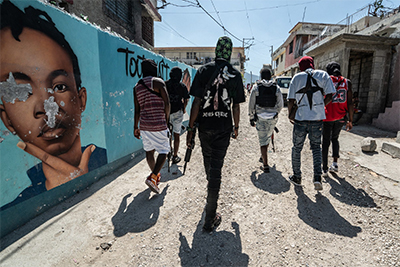
For years, Haiti has lived in a state of suspended hope. Armed gangs hold large stretches of Port-au-Prince and beyond, driving millions from their homes, shuttering schools and markets, and making the simple act of moving through the city an act of courage. Elections have been postponed again and again. Daily life has been reduced to calculation and fear. The status quo has failed, and Haitians know it better than anyone.
Yet the country’s history is not only one of crisis. It is also one of extraordinary resilience and self-determination. That same capacity can be summoned again-if the sequence of recovery is clear and the people leading it are trusted.
Dr. Raymond Pierre, a physician and technocrat with no ties to the traditional political parties and no record of corruption, has outlined a practical path that begins where it must: with security.
His three priorities are straightforward-restore order nationwide, open genuine consultations with Haiti’s vital forces, and organize free, credible elections. Independent and internationally credible, he offers a rare combination of competence and distance from the political machinery that has so often disappointed the country.
El Salvador provides a concrete illustration of what focused action can achieve. Under President Nayib Bukele, the homicide rate fell from more than 100 per 100,000 people to roughly 1.3.
Neighborhoods that had been abandoned to gangs were reclaimed. Streets that once emptied at dusk filled again. The method was decisive and, in many respects, controversial, but the result is unmistakable: ordinary life returned. Haiti’s geography and politics differ, yet the core principle travels-public safety is not one priority among many; it is the precondition for everything else.
That means coordinating and reinforcing Haitian security forces, disrupting gang logistics and financing, reopening roads and neighborhoods, and protecting civilians so that markets, schools, and clinics can function. Once people can move, work, and sleep without constant calculation of risk, the next steps become realistic rather than theoretical.
Those next steps are a technocratic government chosen through free and secure elections.
Competence and measurable results would matter more than political connections. Ministries would be staffed by capable professionals whose mandate is to deliver basic services-electricity, water, justice, health-rather than to distribute patronage. Prolonged unelected transitions would end because Haitians themselves would have chosen their leaders under conditions that allow genuine choice.
Durability requires more than a change at the top. Civil-society organizations can help design and monitor policies. Churches-both local congregations and their international partners-bring moral authority, grassroots trust, and the ability to mobilize communities for peace and reconstruction. Their involvement roots the effort in Haitian society instead of leaving it dependent on external plans.