(Source Black History):
Albert Einstein, often considered to be a genius and the most influential physicist of his time, is described by credible sources as both a racist and a civil rights activist.
Einstein was born in Germany in 1855 to secular, middle-class Jewish parents. He went on to win the Nobel Prize for Physics in 1921 for his explanation of the photoelectric effect. He died in 1955 in Princeton, New Jersey. During his life, he traveled extensively and often shared his opinions with scientific journalists and mainstream media.
According to Forbes, during Einstein’s travels throughout Asia in the 1920s, he used a lot of “racist language” to describe the people of China and Sri Lanka (then called Ceylon). If true, this is no doubt very disturbing and unacceptable. However, Einstein never seemed to have such feelings towards persons of African descent.
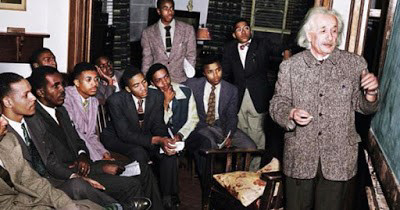
In fact, in 1946, Einstein traveled to Lincoln University in Pennsylvania, the alma mater of Langston Hughes and Thurgood Marshall, and the first school in America to grant college degrees to African Americans, according to The Harvard Gazette. While there he delivered a powerful speech called “Racism: A Disease of White People”
A book entitled Einstein on Race and Racism by Fred Jerome and Rodger Taylor confirms this. These authors assert that Einstein spoke out vigorously against racism both in the United States and around the world. They also insist that the brilliant scientist had a very close relationship with the African American community, and was close long-time friends with the likes of Paul Robeson and W.E.B. Du Bois.
While teaching at Princeton University, Einstein reportedly “realized that African Americans in Princeton were treated like Jews in Germany” and once paid the college tuition of a young Black man from the local community. He also reportedly once invited Marian Anderson to stay at his home when the singer was refused a room at a local hotel.
So why didn’t biographers and mainstream media ever cover this?
Well, according to Jerome and Taylor, Einstein’s biographers did not write much about his friendships with African Americans and his political activities, including his involvement as co-chair of an antilynching campaign, because they feared that mentioning these details would tarnish the feel-good impression that his image lends to topics of science, history, and America.