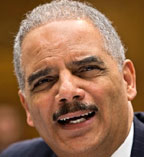
Holder favors voting rights for ex-felons
By Freddie Allen NNPA Washington Correspondent
WASHINGTON, D.C. (NNPA) – If America is ever to end the revolving door of prison recidivism, it needs to ease the re-entry of former offenders back into society by allowing them to vote, Attorney General Eric Holder believes.
Holder announced his position during a recent conference on criminal justice reform at Georgetown University Law Center at Washington, D.C. He called on state officials, state leaders and other elected officials to reform or repeal laws that block ex-felons from voting, more than two million of them Black.
Holder said that some of the laws dating back to the Reconstruction Era were specifically crafted to target Blacks and weaken their voting power, especially in Southern states where most Blacks live.
According to The Sentencing Project, one of every 13 African Americans can’t cast a ballot, due to felony disenfranchisement. In Florida, Kentucky and Virginia more than 20 percent of the Blacks are barred from voting.
Last summer Holder announced the Justice Department’s “Smart on Crime” initiative that includes provisions to reform sentencing guidelines, eliminate unfair disparities and reduce overcrowding in prisons by seeking alternatives to prison time for low-level non-violent crimes.
Holder said that felony disenfranchisement laws often undermine the reentry process and defy the principles – of accountability and rehabilitation – that guide our criminal justice policies.
“And however well-intentioned current advocates of felony disenfranchisement may be – the reality is that these measures are, at best, profoundly outdated,” said Holder. “At worst, these laws, with their disparate impact on minority communities, echo policies enacted during a deeply troubled period in America’s past – a time of post-Civil War repression. And they have their roots in centuries-old conceptions of justice that were too often based on exclusion, animus, and fear.”
Civil rights leaders and criminal justice advocates applauded Holder’s call to lift the ban on voting rights for ex-felons.
“The attorney general’s strong leadership in calling for the repeal of felony disenfranchisement laws across the country is an extraordinary signal to states and the American people,” said Barbara Arnwine, president and executive director of the Lawyers’ Committee for Civil Rights under the Law. “This is the latest in a series of instances in the past year in which the administration has taken great leadership on criminal justice issues. From the statements of Attorney General Holder to the American Bar Association in August, to the implementation of their policies, it shows that they have heard the cries for reforms within the nation’s over-racialized criminal justice system.”
Tanya Clay House, the public policy director at Arnwine’s organization, said that passing the Democracy Restoration Act, a bill co-sponsored by Senator Russell Feingold (D-Wis.) and Rep. John Conyers (D-Mich.) in 2009, would restore the voting rights in federal elections to those disenfranchised because of criminal convictions.
“The Lawyers’ Committee advocates for legislative efforts that restore equality to both the criminal justice system and voting rights,” said House. “Congress can answer the attorney general’s call to action, and lead the nation by example, by reintroducing the Democracy Restoration Act. This bill would restore the voting rights in federal elections to those disenfranchised because of criminal convictions.”
During the same conference, Senator Rand Paul (R-Ky.) repeated his support for repealing felony voting restrictions in his state. Alabama Republican Gov. Robert Bentley also expressed support for restoring voting rights for felons who completed their sentences. In 2003, state officials in Alabama passed legislation streamlining the process to restore voting rights for most ex-felons. Nearly 15 percent of Blacks are disenfranchised in the state.
Wade Henderson, president and CEO of The Leadership Conference on Civil and Human Rights said, there is undeniable bipartisan momentum for criminal justice reform that would update inhumane sentencing laws and return people to society with dignity.
“America is the world’s greatest democracy, yet felon disenfranchisement laws deny almost six million Americans the right to vote,” said Henderson. “These laws serve no purpose but to make it harder for returning citizens to reintegrate into their communities – to work, seek an education, and participate in our democracy. Successful reintegration and smarter sentencing are the keys to ensuring that our criminal justice system is more fair, more humane, and more fiscally responsible.”
In prepared remarks, Holder also addressed states that continue to “restrict voting rights, to varying degrees, even after a person has served his or her prison sentence and is no longer on probation or parole.”
In Florida, the state with the highest population of disenfranchised residents, almost 1 in 4 Blacks is disenfranchised and in Mississippi almost 14 percent of the Black population can’t vote because of a prior felony conviction. Iowa’s Republican governor reversed an automatic restoration order in 2011, placing an additional hurdle in the way of returning citizens. Two years later, Holder said less than 12 people out of 8,000 that have completed their sentences during the current governor’s tenure can vote in the next election.
“That’s moving backwards – not forward. It is unwise, it is unjust, and it is not in keeping with our democratic values,” said Holder. “These laws deserve to be not only reconsidered, but repealed.”