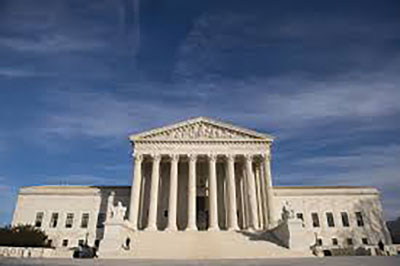
The Supreme Court began hearing arguments against the Affordable Care Act in one of Trump’s final policy swipes at Obama and his signature healthcare law.
By Bruce C.T. Wright and Nigel Roberts
(Source NewsOne)
The Affordable Care Act appears set to survive its third challenge after the U.S. Supreme Court on Tuesday heard the latest arguments against President Barack Obama‘s signature healthcare law more commonly known as Obamacare. While certain elements of Obamacare remain at risk of being eliminated, two Supreme Court justices suggested the overall law would remain intact. For now.
The showdown on Capitol Hill came one week after the presidential election and nearly a month following Donald Trump‘s successful nomination of Amy Coney Barrett in hopes she would play a role in helping to repeal Obamacare.
The looming ruling in the case has serious implications for Black people, in particular, as the coronavirus pandemic continues to disproportionately affect that underserved community.
The highest court heard the case Tuesday at the urging of the White House, which is in lame-duck mode after Joe Biden won the presidential election last week. Biden has announced his own healthcare plan that he says he intends to institute in his first 100 days in office. But Trump likely saw an opportunity to take one of his last policy swipes at Obama.
CNBC reported: “Chief Justice John Roberts, who cast the key vote in 2012 upholding Obamacare, and Justice Brett Kavanaugh, an appointee of President Donald Trump, suggested that the court may cast aside a challenged provision of the law, known as the individual mandate, while leaving the rest of it standing.”
At stake is the health coverage of 20 million Americans enrolled in Obamacare, which has narrowed the racial gap in health care coverage. The case goes before the Supreme Court as a strong second wave of Covid-19 sweeps across America, including the White House, where multiple high-level staffers, as well as Trump, have been infected by the infectious virus. As of Tuesday morning, more than 239,000 Americans have died from a pandemic that Trump has repeatedly downplayed as a political conspiracy theory.
Democrats have feared that the expedited addition of Justice Barrett to the Supreme Court to fill Ruth Bader Ginsburg‘s seat vacated after her death in September could prove to be the undoing of Obamacare. Critics suspect Trump selected the anti-abortion judge specifically to help him repeal Obama-care, something that she did not refute when questioned by now-Vice President-Elect Kamala Harris during her Senate confirmation hearing last month.
“The horrifying truth is … they’re fighting to take health care away from people in a pandemic,” Harris said at the time about the Trump administration. “The reality is right now he’s asking the Supreme Court to take it away, period.”
Barrett answered in part by saying she did not “recall hearing about or seeing such statements.”
That’s when Harris went into prosecutor mode and set up Barrett with a series of questions that centered on whether the judge ever considers the feelings of the people in her cases. When Barrett said that every case requires her to do so, Harris mentioned how ending Obamacare would al-low insurance companies to “discriminate” against Black and Latino patients and cited Covid-19 statistics showing how the coronavirus has disproportionately affected people of color.
“Will you consider the feelings of these people?” Harris asked Barrett. “What weight would you give that?”
Barrett responded in legalese jargon that proved to be a non-committal answer.
“Consider how the destruction of [Obamacare’s] protections would have a devastating effect,” Harris appealed to Barrett.
The 2010 health care law, which passed with only Democratic votes, went into effect in 2014 and opened the door to a variety of coverage options for low- and moderate-income individuals who had no health insurance. The options included an expansion of Medicaid coverage in some states.
“People of color experienced large gains in coverage under the ACA that narrowed longstanding disparities in coverage. Research suggests these gains will likely lead to reductions in disparities in access to and use of health care as well as health outcomes over the long-term,” said a Kaiser Family Foundation analysis of Obamacare that was released in March.
Before Obamacare went into effect, people of color were at a much higher risk of being uninsured compared to whites. About 19 percent of African Americans were uninsured, which doesn’t take into account the scores of Black people who received minimal health coverage on low wage jobs. At that time, 12 percent of whites were also uninsured.
By 2017, the uninsured rate of Black people fell to 11 percent, while 7 percent of whites also had no health care coverage.
Trump came into office in 2017 vowing to repeal Obamacare and replace it with something better—a vague plan that has never materialized. Even though Republicans controlled Congress in his first two years in office, the GOP failed to put forward an alternative health care plan that received widespread public support or was able to pass in Congress.
The president has given more evidence that he’s willing to lie about Obama’s signature health care reform for political gain.
Trump falsely claimed in the weeks before the 2018 midterm elections that it was a Republican priority to ensure coverage for those with asthma, diabetes, pregnancy and other conditions. He hoped that his base would ignore that the GOP tried but failed for years to end Obamacare, which has become more popular among poor white conservatives who benefitted from health care reform.
“Republicans will totally protect people with Pre-Existing Conditions, Democrats will not! Vote Republican,” Trump tweeted.
He appears to be trying the same ploy for this year, too.