
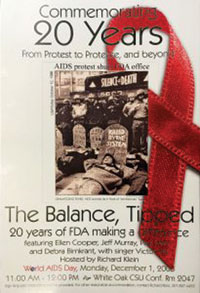
 A Look Back: The AIDS crisis and FDA … 30 years later
Twenty years after the protest at FDA headquarters, the world had moved from protest to protease inhibitors, and beyond.
By Richard M. Klein
The first patient-focused office at FDA – and very possibly the first patient engagement office in the federal government – was the Office of AIDS and Special Health Issues, established in 1994 at the height of the AIDS epidemic.
Richard M. Klein, a former entomologist in the agency’s New York Laboratory who had been working on human research protection policy at FDA’s suburban Washington, D.C., headquarters, was instrumental in setting up the new office. He recently sat down with FDA Voice to talk about his work with patient engagement during the AIDS epidemic.
Could you set the scene for us? What was it like as the AIDS epidemic grew in the years and months leading up to the creation of the Office of AIDS and Special Health Issues?
Twenty years after the protest at FDA headquarters, the world had moved from protest to protease inhibitors, and beyond.
It was a desperate time. People lived 6 to 18 months after diagnosis. There was a pervasive sense that the government was not doing anything. One day in October 1988, the advocacy group ACTUP (AIDS Coalition to Unleash Power) functionally closed down the FDA. They surrounded the building at our Parklawn Headquarters in Rockville, Md., preventing employees from getting into the building. FDA saw other forms of protest as well. The director of the first antiviral division, created to address AIDS, received death threats. Individuals continually called up various offices of FDA complaining that no one at FDA was paying attention to AIDs. There were “fax attacks” – repeated attempts to send faxes clogging the phone lines. It was designed to disrupt “business as usual,” because they thought AIDS shouldn’t be business as usual. I was working in the New York lab at the time, and the community in New York was overwhelmed by this epidemic. People were getting sick left and right. I worked with a guy in the lab who contracted and later died from AIDS. That’s when I decided I wanted to take a more active role with AIDS and when the opportunity came up, I knew it was something I needed to do.
What did FDA do?
I mentioned the creation of the antiviral division to focus on AIDS drug development. There was also a National Commission on Aids with which we were involved. And FDA was integral to the National Task Force on AIDS Drug Development, a public/private effort brought together government, industry, academia, and patients to identify and remove barriers to successful drug development. Initially, FDA’s AIDS activities were coordinated by CBER since so many issues early on involved the blood supply, but then responsibility was shifted to the Office of the Commissioner. That’s when the new Office of AIDS and Special Health Issues was established to better communicate with the public and coordinate AIDS activities. The idea was to insulate the review division so they could do their work – and we would take the phone calls and we would get the faxes. The phone calls in the beginning were really terrible. People would say, “Murderer. Nazi. FDA is not doing anything; you are killing people,” and I wondered, what did I open myself up to?
We were the insulator, but also the conduit to the review divisions.
Tell us how you interacted with the AIDS community in those early days.
After the first meeting of the Task Force, I went down to Connecticut Avenue and had a couple beers with one of the major activists, Moises Agosto. I told him, I’m starting in this new job. What do you guys need and want? It was a really great conversation that I think opened up relationships. Later, when AIDS drug applications were filed with FDA, I would go to the advisory committee meetings and I would sit with the AIDS activists, rather than FDA staff. It gave me the opportunity to really know the community issues as we talked together about the proceedings.
Do you think that education was one of your principal roles?
Yes. I thought, if I could rationally explain to people how things work, how drugs get developed and why you can’t rush it, that you can’t expect it to turn out well if you don’t have the data, people would listen and open up to the idea that regulation has a real purpose. I would go to scientific meetings and companies with their marketing people would be there.
