 Med students don’t wait to give back
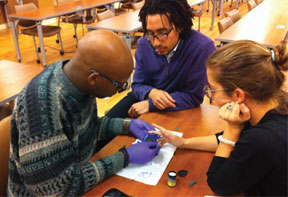
Future medical professional begin helping communities long before they earn their medical degree. (Photo by Michael L. Jones)
By Jazelle Hunt NNPA Washington Correspondent
WASHINGTON, D.C. (NNPA) – According to the American Association of Medical Colleges, there are only 2.3 physicians for every 1,000 people in the United States. That number is even lower in some states with large African American populations, such as South Carolina, Georgia, Texas, Alabama, and Mississippi.
Enter the Student National Medical Association. The SNMA is the oldest and largest student-run organization of medical students of color. It not only cultivates the pool of medical professionals of color and nurtures thousands of mostly African American student members as they matriculate through medical training, but it also instills a duty to serve, particularly in communities where health care access is inadequate.
“The people in this organization are the next wave of medical leadership, and will practice largely in underserved communities of color,” says SNMA national marketing manager, DeJuana Thompson. She began positioning herself for her current position after seeing SNMA members from the University of Alabama chapter volunteer clinic services around her hometown of Birmingham. “They were offering medical services in our com-munity that we normally didn’t have access to. Once I saw that, I’ve been involved ever since.”
In 2011 when Thomson began working with the SNMA, a new initiative to deepen the SNMA’s community impact was brewing next door in Mississippi. That year, a team led by Michael L. Jones at the University of Mississippi Medical Center, launched the Community Health Advocacy Training Program. The program partners with churches and other community hubs to train lay people to become health advocates in their neighborhoods.
“Mississippi leads the nation in most chronic diseases, such as high blood pressure, obesity, diabetes, and heart disease,” says Jones, who works as the director of Healthy Linkages at the University Medical Center while running the CHAT program in his spare time. “But we also have low rates of health literacy, and a low number of primary health care physicians.”
In one free six-hour training, volunteers learn to accurately measure blood pressure, weight, body mass index, and glucose levels, interpret medication instructions, provide basic nutritional counseling, and help others navigate the health care system. The program also trains both lay people and medical professionals to create more advocates by teaching others these clinical skills. To date, Jones and his volunteer partners have trained approximately 2,500 advocates, mostly in the Jackson, Miss. area.
“We wanted to devote attention and resources to laypeople in the community, and empower them to take a more active role in their healthcare,” Jones explains. “Because if we could empower those individuals, they’re the ones who touch people every day. They’re the ones who are trusted in their com-munities. I’m not going to be able to have the same reach.”
The following year, Amber Clark, a student at Brown University Alpert Medical School (and then-community service liaison for SNMA Region 7), learned about Jones and the CHAT program through a mutual colleague and brought it to the SNMA. For the 2013 SNMA Community Health Advocate Training pilot program, Jones trained 25 medical students of color from all over the country to go into their schools’ surrounding communities and develop more community health advocates.
“We wanted a wildfire effect,” Clark explained. “This program is important for minority communities because we’re the most adversely effected by these disparities that are 100 percent preventable. We have to let [communities] know, you have a say in your health, and we’re giving them the tools to do that. It’s very up-lifting and empowering.”
The CHAT program isn’t the only way SNMA student members address their communities’ disparities.
Project H.O.P.E. (Health Optimization through Patient Education) is another major initiative from the student members of the University of South Alabama College of Medicine chapter. The program brings together high school students and members of their community living with HIV/AIDS for monthly conversations.
“African Americans ages 15-24 are among the highest groups of individuals being infected with the HIV/AIDS virus,” the project’s mission statement explains. “It is our belief that by educating our youth about the detrimental effects of HIV/AIDS, we can counteract and/or slow this number.”
The organization is also looking beyond the big-name ailments that Black communities suffer disproportionately. The Michigan State University College of Human Medicine chapter of the SNMA, for example, hosts an annual bone marrow drive targeted at donors of color in the Lansing, Michigan area.
According to the National Marrow Donor Program, (the largest marrow registry in the world, each year 12,000 Americans need a bone marrow transplant to save their lives, and 70 percent will not have a donor match within their families. They will need to look to unrelated donors, who must be the same race and ethnicity to increase the chances of success. But only 7 percent of bone marrow donors are African American. Black patients who need a transplant to survive have a less than 50 percent chance of finding a matching nonfamily donor.
“MSU-CHM SNMA is dedicated to making bone marrow available for those groups that are less likely to find a match,” the chapter explains. “The National Marrow Donor Program could save the life of anyone anywhere in the world.”
Incoming SNMA national president and Wright State University Boonshoft School of Medicine student, Topaz Sampson, takes the commitment to serve underserved populations very seriously. With her tenure, she plans to broaden the SNMA’s focus to include the needs of LGBT, immigrant, and refugee communities.
“Because we’re a socially conscious and culturally competent organization, we have to be prepared to treat patients from all walks of life,” says Sampson, who is interested in becoming a psychiatrist. “We recognize this great lack in representation and access and we have to be the best physicians we can be in our communities.”
Clark, who hopes to go into physical medicine and rehabilitation, also believes that an emphasis on community service within medical training has far reaching effects.
“This may sound crass, but just because you’re smart doesn’t mean you’ll make a great physician. You need people skills, you need to be able to relate to your patients, and serving the communities in which you’ll be working fiver you those skills,” she says. “For a community, it’s great to see people who look like you, screening you. It’s very empowering and uplifting, and it leads to better health for all of us.”