 New CDC study: 185,000 HIV infections could be prevented in U.S. by 2020
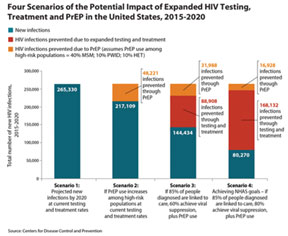
The Centers for Disease Control and Prevention in Atlanta details the effect of expanded HIV testing and PrEP according to four different scenarios.
Reaching the National HIV/AIDS Strategy (NHAS) targets for HIV testing and treatment and expanding the use of daily pre-exposure prophylaxis (PrEP) could prevent an estimated 185,000 new HIV infections in the United States by 2020 – a 70 percent reduction in new infections, according to researchers at the Centers for Disease Control and Prevention (CDC).
The study, presented last week at the Conference on Retroviruses and Opportunistic Infections in Boston, uses a forecasting model to predict the impact of these key prevention strategies. Based on the reach of each strategy, CDC researchers examined the impact of fully achieving NHAS goals, as well as several alternate levels of success (see additional graphic).
Reaching the nation’s treatment goal of ensuring 80 percent of all of those diagnosed with HIV achieve viral suppression (that is, keeping their virus under control and at a level that dramatically reduces the risk of transmission) alone would prevent an estimated 168,000 infections over the next five years. Increasing the use of PrEP, a daily anti-HIV pill, among people who are uninfected but at high risk could prevent an additional 17,000 infections over the same time span.
Currently, however, less than a third of Americans with HIV are on sustained treatment that effectively keeps their virus suppressed. And too few people who are at substantial risk for HIV and who could benefit from PrEP are receiving it.
“If we expand the use of our current prevention strategies today, we can significantly re-duce new HIV infections tomorrow,” said Jonathan Mermin, M.D., director of CDC’s National Center for HIV/AIDS, Viral Hepatitis, STD, and Tuberculosis Prevention. “This study confirms that we have the right tools to dramatically reduce new HIV infections, but we have a long way to go in order to make those reductions a reality.”
The study also models the
impact increased PrEP use by people at high risk of infection could have at current levels of viral suppression in the U.S., when the risk of HIV trans-mission is substantially higher.
If testing and treatment rates were to remain the same over the next five years, expanding PrEP coverage alone could reduce new infections by nearly 20 percent, preventing more than 48,000 new HIV infections.
Results suggest that as the nation works to expand the reach of HIV treatment, PrEP can play a critical role in protecting those currently at high risk for HIV infection.
“We urgently need to close gaps in HIV care and treatment for people living with HIV,” said Eugene McCray, M.D., director of CDC’s Division of HIV/AIDS Prevention.
“At the same time, in the short term, we need to rapidly expand access to PrEP and other life-saving prevention tools.”
Researchers also presented interim scenarios, examining the potential impact of reaching 60 percent of those living with HIV with effective treatment and viral suppression. Even this level of success would substantially reduce new infections.
Findings from the study highlight the importance of implementing the National HIV/AIDS Strategy, which sets ambitious goals to inspire and mobilize the national response to the epidemic. First issued in 2010 with 2015 targets, the Strategy was recently updated through 2020.
For additional information, visit www.cdc.gov/nchhstp/newsroom.