 Police abuse debate is more than a Black-White issue
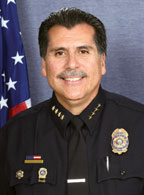
Long Beach Police Chief Robert Luna the first Latino to lead this law-enforcement agency
By Luis Vasquez-Ajmac,
Urban News Service
While the national conversation on police and race seems like a Black and white issue, many Latinos say they also feel mistreated by cops.
“I grew up in East L.A., in an economically depressed neighborhood,” said Long Beach Police Chief Robert Luna, the first Latino to lead the Los Angeles area’s second largest law-enforcement agency. “I did not have the most positive contact with the police or the people around me. I very much understand the concerns.”
Many Latinos report abusive experiences and negative opinions toward police, similar to those that numerous African-Americans have expressed nationwide, according to a survey by the Associated Press-NORC Center for Public Affairs Research.
“Excessive police use was a huge issue for the Hispanic America community,” said Jennifer Benz, AP-NORC’s deputy director. Beyond answering this study’s specific questions, some respondents volunteered that “they or someone in their family was harshly treated by the police at far higher levels than whites,” Benz said.
This is not just a white-and-Black issue, according to Benz. “Across the country, roughly four in 10 Americans believe the reason for police violence is overall problems with race relations in our society,” she said. “Three-quarters of Americans think it would be more effective to have diverse police forces nationwide.”
AP-NORC polled 1,200 white, Black and Latino Americans on these topics in July 2015.
Law enforcement “has a lot of work to do, to continue the dialogue and talk about the excessive use of force,” said LAPD Captain Tina Nieto, incoming president of the Hispanic American Police Command Officers Association.
The L.A. native echoes those who advocate closing racial disparities by recruiting and hiring more people of color. “It’s very important to make an attempt to have a police force that reflects the community that you are servicing,” Nieto said. “I believe when your police force reflects the community, there are better outcomes.”
Bryan Stevenson, executive director of the Equal Justice Initiative, said that where officers reside affects these matters. “We need officers to live in the communities where they police,” he said. “When they live outside the cities that employ them and commute in from neighborhoods that have very different, less diverse demographics, problems are aggravated.”
The Manhattan Institute’s Heather McDonald disagrees.
“This is an irrelevant consideration. It’s the classic Black Lives narrative that embraces the white cop/Black victim line-up,” said the author of the new book, The War on Cops.
“The Justice Department came out with a report last year in Philadelphia. It found that Black and Hispanic officers were far more likely than white officers to shoot an unarmed Black suspect. I think the inquiry of an officer’s skin color is largely a side show,” she said.
Rene Galindo, a telecom network engineer for 2talk, grew up as a Mexican-American in South Central L.A. He said there are two systems of law: one for whites and another for people of color. “You thought it was normal for cops to stop you for no reason, check your personal property under no suspicion at all,” Galindo said. “I’ve been held for no apparent reason, just for walking home from a friend’s place at night.”
Nieto, however, said police do not confront people willy-nilly. “I know we are not just stopping you because we want to stop you,” she said. “We are way too busy in the city of L.A. Citizens can always request a supervisor to the scene if you believe officers are doing something they are not supposed to do.”
“Many people of color do not see cops as protectors, but we see the opposite,” said Dolores Huerta, co-founder of the United Farm Workers union, which represents thousands of Mexican-American agricultural laborers. “They harass, intimidate and brutalize people of color and kill.”
White Americans have it different, some say.
“In most situations, white people are not presumed dangerous or guilty,” said the Equal Justice Initiative’s Stevenson. “Because most police officers are white, this means that white people face a different level of threat and risk when they encounter the police.”
Despite racial gaps in perceptions of law enforcement, most Americans say they want more diverse police forces to ease ethnic tensions.
“It’s not surprising for those of us aware of how the Latino community across the country has been treated by police,” said Thomas A. Saenz, president of the Mexican-American Legal Defense and Educational Fund. “We need to recruit a more diverse police force.”