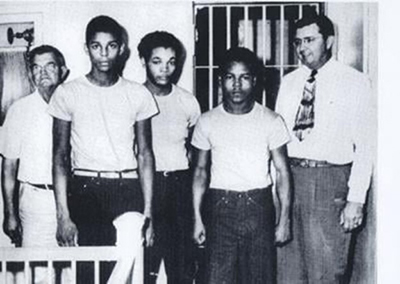
By Gabrielle Russon, Florida Politics
(Source: The Miami Times)
More than 70 years ago, four young Black men falsely accused of rape became the victims of a powerful Florida sheriff and a broken legal system.
Now, the Senate has unanimously passed SB 694 to pay the Groveland Four’s surviving family members $4 million, years after Charles Greenlee, Walter Irvin, Samuel Shepherd and Ernest Thomas were fully exonerated. The Senate vote was 38-0.
The House companion bill (HB 6523) has failed to move yet, however. House Speaker Daniel Perez did not respond to Florida Politics’ questions last week on the likelihood of the lower chamber advancing the bill.
In 1949, 17-year-old Norma Padgett and her husband’s car broke down on the side of the road. Shepherd and Irvin stopped to help the white couple.
In the Jim Crow South, a fight broke out. Perhaps the conflict was over Norma sharing a whiskey bottle with one of the Black men, angering Norma’s husband, a historian and journalist later theorized.
What happened next, lawmakers said, was a miscarriage of justice.
Thomas was shot more than 400 times by an angry mob. When transporting two of the men to jail, Sheriff Willis McCall and Deputy Sheriff James Yates fired at them. A handcuffed Irvin survived by playing dead, Shepherd was killed. And Greenlee served 12 years in prison.
“For decades, the families carried the weight of wrongful convictions, wrongful incarcerations, and wrongful death. Decades of growing up without fathers, without brothers, without sons. Florida has since acknowledged the truth. Senate Bill 694 represents the final step,” said Sen. Lavon Bracy Davis, who sponsored the bill as a first-term senator.
“Let us close this chapter with integrity. Let us show the families that we heard them and let us send a message that in the Florida state Senate, truth still matters.”
Some of the Groveland Four’s family shared about the generational trauma they faced while speaking earlier in the week at a panel sponsored by the Legislative Black Caucus.
“Growing up as a child, I had to sit there and watch Sam’s mother, my father’s sister, come to the house, sit at the table and cry all the time about ‘they killed my baby.’ I never knew what she was talking about because I was so young,” said Beverly Robinson, a descendant of Shepherd.
As a child, Vivian Shepherd didn’t understand why her father — Shepherd’s brother — worked late, alone, in the garage. The mechanic never talked about his brother’s death.
“I could only imagine what it made them feel like to not be able to do anything back in that era of life,” Vivian Shepherd said. “If I can do something now, that’s what I wanted to do. I wanted to make sure that their names are clear. Their names are free.”
How the Groveland Four ended up being debated on the Senate floor in 2026 is a story of modern-day leaders unwilling to forget the past and vowing to fix the state’s mistakes from decades ago.
“I want to give credit to the state of Florida for understanding the importance of acknowledging this because it really goes to the credibility of the court system. And if you’re unwilling to address these gross injustices from the past. It’s not really a good look for the present day,” said Pulitzer Prize-winning author Gilbert King, who wrote about the Groveland Four in his book “Devil in the Grove” that brought more attention to the case.
King called the Legislature’s efforts “hopeful.” Supporters along the way were “heroes,” he said.
One was the late Sen. Geraldine Thompson, a civil rights leader and a historian herself, who championed exonerating the Groveland Four at a time when many Floridians have never ever heard of the tragedy, King said.
Bracy Davis now holds Thompson’s seat following her death last year.
Lake County State Attorney Bill Gladson kept looking for the lost trial evidence, which sparked the path to posthumous exonerations.
A faded cardboard box contained a pair of pants that a trial prosecutor implied had a stain it — proof that Norma Padgett was raped, even though the pants were never tested back then.
But Gladson tested it.
Modern-day DNA testing showed it was a lie. The stain wasn’t from a human.
Ron DeSantis, running for his first term of governor, promised to pardon the Groveland Four, which he did just days after taking office in 2019.
“He was committed to this from Day 1,” King said.
DeSantis did not respond to a request for comment on the bill and if he would sign it if the Legislature passes it.
King speculated that DeSantis would be a supporter again.
“I would imagine he would sign it. It seems like this is a continuation of what he promised along the campaign trail when he first ran for governor,” King said, calling it a bookend to his legacy.