 The Black Press played vital role in ‘Hidden Figures’
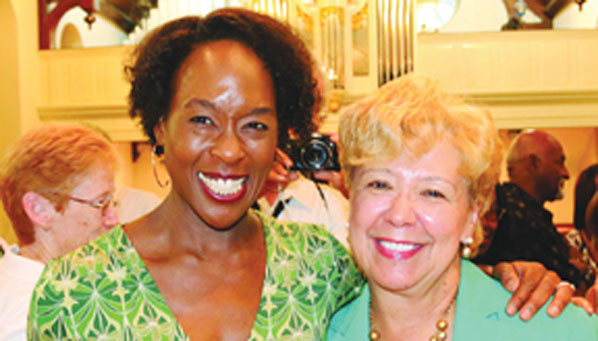
“Hidden Figures” author Margot Lee Shetterly (l) poses for a photo with New Journal and Guide publisher Brenda Andrews. (Ernest Lowery/New Journal and Guide)
By Stacy M. Brown (NNPA Newswire Contributor)
In her book, “Hidden Figures,” author Margot Lee Shetterly pays homage to the African-American women who worked as human computers in the space program.
It’s a book that’s spawned an Academy Award-nominated movie and has brought to the fore the accomplishments of Katherine Johnson, Dorothy Vaughan and Mary Jackson, the brilliant Black women who worked at NASA serving as the brains behind America’s nascent space program starting in the 1950s.
Inside the book, Shetterly also pays homage to where she first got the notion to write such a historical masterpiece.
“In the first week of May 1942, the ‘Norfolk Journal and Guide’ published an article that would…be like a signpost for the road not taken,” Shetterly said.
She even recalled the headline that accompanied the piece in one of the nation’s oldest African American-owned newspapers.
“Paving the Way for Women Engineers,” the headline blared.
An accompanying photo revealed 11 immaculately dressed Black women in front of Hampton Institute’s Bemis Laboratory, graduates of Engineering for Women, a war training class.
The Journal and Guide’ and the Pittsburgh Courier, two of the granddaddies of the Black Press, are mentioned prominently inside the hard cover copies of the book with a picture that dates back to the 1940s,” said Brenda Andrews, president, publisher and owner of the New Journal and Guide.
The Journal and Guide published its first issues in 1900 and, during the World War II, by many accounts, was the lar-gest Black employer in the South, according to Andrews.
Its circulation topped 100,000 and Andrews said the newspaper joined others like the Chicago Defender, the Baltimore Afro-American and the Pittsburgh Courier in taking the lead in writing about Black interests and recording African American his-tory.
“We were hidden figures ourselves until about the 1960s,” Andrews said of the Black Press in America, which this year celebrates 190 years in operation. “This story and how the author researched ‘Hidden Figures’ is an example of what the Black Press has been doing, which is recording Black history.”
Andrews continued: “When I speak with people, even today in the 21st century, people are curious about the Black Press’ role. We were in the shadows in our community, doing the work, recording information.”
Andrews said the Black Press wasn’t formerly recognized for its great journalism, seen mostly as underground activists.
“Even today, we’re not properly recognized for recording that history. We were hidden in Black areas among Black people,” she said. “It came about that World War II was significant, because it was our activism that stories of segregated troops were told.”
During World War II, the Black Press led the call for a “Double V” victory against fascism abroad and against Jim Crow in the United States.
Reportedly, with such a slogan, many historians regarded this campaign as the ground-work for the Black activism that characterized the Civil Rights Movement.
Black newspapers, led by the Norfolk Journal and Guide,” the Chicago Defender, the Pittsburgh Courier and the AFRO, took a conservative effort and channeled Black militancy into nationalistic ends.
They sought government concessions and they looked to create a homogenous American identity that included Black citizens to resolve struggles for full citizenship, freedom, and racial justice.
During World War II, the Journal and Guide reported regularly on soldiers serving overseas.
The newspaper even sent correspondents into battle to report on heroism that rarely made the front pages of the mainstream papers.
Embedded writers and photographers sent stories back home of patriotic service including re-ports from the U.S.S. Mason, one of only two U.S. Navy ships with an African-American crew.
“It wasn’t until the 1960s and segregation [reform efforts] and the civil rights that Black newspapers came out of hiding,” Andrews said.
Andrews added: “But, if it had not been for the Black Press in World War II telling our stories, much would have gone unknown. It’s very redeeming that our mission is recognized now.”
With the success of the book and movie for “Hidden Figures,” Andrews believes history will continue to tell the glowing story of the Black Press.
She said the current atmosphere makes it quite difficult to appreciate now, but it’s her hope that in the future, when individuals reflect, they will know that the Black Press did its job and well.
“That’s why it’s important to tell our own stories and refuse to let others portray who we are,” said Andrews. “The Black Press isn’t just about news stories; we’re recording our history as only we can.”