By the Westside Gazette Editorial Team
As Black History Month unfolds, this week reminds us that progress has never been accidental. It has always been pushed forward—by students who refused to accept second-class citizenship, by writers who told the truth about Black life, and by everyday people whose quiet resolve shook the nation.
When Students Sat Down—and a Nation Took Notice
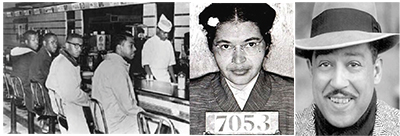
On February 1, 1960, four freshmen from North Carolina A&T State University sat at a segregated Woolworth’s lunch counter in Greensboro, North Carolina, and refused to move. Their action—now known as the Greensboro Sit-Ins—ignited a wave of nonviolent protests across the South and energized a new generation of young activists.
Reflecting on the mindset of that moment, sit-in leader Franklin McCain later said, “We were tired of being treated as second-class citizens.” It was not recklessness but resolve an insistence that dignity could no longer be deferred.
Bishop Staccato Powell placed that historic moment into a broader spiritual and generational context:
“On February 1, 1960, those four courageous students strolled from the campus of NC A&T to sit at the counter of Woolworth. Their stroll was not fortuitous but divinely orchestrated so sixty-six years later we as people of melanin pigmentation could walk with heads high and sit without encountering codified discrimination in any establishment for breakfast, lunch, or dinner.”
That legacy, Powell suggests, is not abstract, it is lived daily in freedoms once denied.
The Black Press as Witness and Archivist
The Greensboro Sit-Ins also underscore the essential role of the Black Press in documenting, preserving, and honoring these moments of transformation. Dr. Benjamin F. Chavis Jr., President and CEO of the National Newspaper Publishers Association (NNPA), reflected on the movement’s enduring impact and the responsibility of Black-owned media:
“The National Newspaper Publishers Association not only reports the news, but we also salute those freedom fighters who helped us on the pathway to freedom, justice, and equality. As we approach the 200th anniversary of the Black Press, we recognize that the Black Press has been the depository and the archivist of those bold, courageous acts by a few that brought relief to millions.”
Dr. Chavis emphasized that the Greensboro Sit-Ins led by four students from the nation’s largest HBCU sparked a movement that spread rapidly across the Deep South, engaging some of the sharpest young minds of the era.
“Those four courageous students four brothers went into a Woolworth store in Greensboro and refused to leave when they were denied service because they were Black. That single act started the student sit-in movement that spread from North Carolina throughout the South. We must always be grateful and mindful of those four heroes whose courageous action benefited millions of our people.”
As the nation prepares to mark 200 years of the Black Press, the sit-ins stand as a reminder that history survives because someone chose to record it and to tell the truth.
The Poet Who Taught America to Listen
This week also marks the February 1, 1967, passing of Langston Hughes, one of the most influential literary voices in American history. A central figure of the Harlem Renaissance, Hughes wrote about Black life with honesty, humor, and unflinching clarity.
Educator and poet Katrina “Poettis” Sapp reflected on Hughes’ lasting impact:
“Langston Hughes was the first poet that I formally studied in school, and the first poet that I would expose my 6th graders to when I began teaching middle school English. He gave us comedy and tragedy in poetic form. From his witty rhyme scheme in Ballad of the Landlord*, to his commentary on Black life in the United States in* I, Too, Sing America*, Langston Hughes’ literary legacy influences readers and writers to this day.”
Her words echo what generations have experienced Hughes did more than write poetry. He taught Black children to see themselves in literature and taught America to hear voices it often tried to ignore.
A Birthday That Sparked a Movement
Born February 4, 1913, Rosa Parks would come to symbolize the power of quiet resistance. When she refused to give up her seat on a Montgomery bus in 1955, she ignited the Montgomery Bus Boycott and helped launch the modern Civil Rights Movement.
Former Broward County Transportation Director, Chris Walton
Parks later made clear that her action was not about physical exhaustion, but moral resolve: “The only tired I was, was tired of giving in.” In that single sentence, she captured the spirit of a movement—and the strength required to stand firm when the world expects compliance.
Then, and Now
The lessons from this week in Black history are unmistakable. Change comes when students stand their ground, when the Black Press preserves truth, when educators pass on culture, and when ordinary people refuse to accept injustice as normal.
These are not just moments from the past. They are instructions for the present and a reminder that the work continues.