
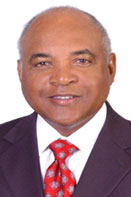
Former Broward County Commissioner Josephus Eggelletion, Jr. speaks candidly about his life
By Charles Moseley
Last week, the Westside Gazette Newspaper began to tell the story of one man’s experiences as a public servant, the ups and downs in life, his fall from grace, and now his attempt at finding redemption. That man was Josephus Eggelletion, Jr. , former County Commissioner and Broward County’s first Black mayor.
The 63-year-old Eggelletion recently agreed to share some of his thoughts with the Westside Gazette Newspaper.
Westside Gazette (WG): How are you doing today mentally, physically, and spiritually?
Eggelletion: “Other than my health problems, I’m doing okay; other than those things, I’m doing good. Mentally I’m fine. Spiritually I’m even better. I feel very good spiritually. God has blessed me in many ways.
“I had an opportunity when I was away to find that closeness and just to be still for a minute. I was so busy, although I would attend church I didn’t have that closeness that I developed when I was away to God. I feel that closeness and I feel its tug toward the direction it’s been pu-ling me in for a period of time and I feel good about that.”
WG: What has been your source of strength during the difficult times you’ve faced in your life?
Eggelletion: “My source of strength has always been trusting in God. I was reared in the church-First Baptist Piney Grove. Growing up I had very good church role models, my parents first of all and in our church, First Baptist Piney Grove we had a very strong youth department growing up. And so people like Eddie Pearl DeGraffenreidt, like Eula Mosby, and Janie Stewart. Those individuals were very involved with us growing up. Susie C. Holley, all those individuals made sure that we as youth had all the tools that were necessary from a church perspective.
“We had very strong men leaders like Rev. Toomer, Deacn Bizell Robinson – all those individuals were involved with us, so that was a strong foundation for me. That has always stayed with me all of my life, even in my adult life. So at-tending church and praying have always been my strong point. Just being able to pray and ask God for his guidance, depending on God for his guidance has been my strength.”
WG: What have you learned as a result of some, what you admittedly said, have been some poor choices in life?
Eggelletion: “I’ve learned first of all that I’m human and as a human I’m going to make mistakes. I try not to wallow in my mistakes. I’ve learned from them. I’ve learned how to do things differently the next time. Growing up in life I’ve found you’re going to have your share of mistakes. You’re going to have your share of temptations. You just have to be strong and avoid falling. What I’ve learned is that you have a choice, and it’s the choices that we make that either make or break us. When you make negative choices what you have to do is identify what caused you to make that choice and then correct it in the future.”
WG: Obviously, you went from being one of the most powerful political figures locally into a totally diff-rent realm having gone through being incarcerated. How did you deal with experiencing that transition?”
Eggelletion: “First of all, I chose not to go through a trial. I felt that the best course of action for me given the circumstances, my illness and my parent’s ill health. I felt the best thing to do was not to put them through a trial. And I’d have to say mentally I wasn’t at a point where I could deal with a trial. I had had one surgery and was scheduled for a second one for cancer. I kept those things very quiet and the two surgeries took a lot out of me physically. The fact that I had the “Big C” mentally weighed on me and it weighed on my family. So I felt the best course of action was for me, first of all, was not to go through a trial. So I chose not to have a trial, to take a plea, to go to prison, to come out and start all over again. That was my choice.
“My lawyers wanted me to go to trial but my choice was not to do that. It has made a significant dent in my life. One of the things that you learn in going through that process is you learn a little bit more about this government and how this government actually operates. I had some revelations in prison of some things that I didn’t know; the impact of many laws that we pass is tremendous.
“One of the most important lessons I learned is that when you go to prison, you don’t just go to prison; you put your whole family in prison. That’s critically important to understand the impact of that on your family members and what it means to them and how it’s going to impact them. So that part of it I really regret of having put my family through that. But, I made that choice and I have to live with that for the rest of my life.”
WG: You’ve spent the majority of your professional career in public service. What was it like not doing what you had been doing for so long?
Eggelletion: “I didn’t necessarily miss it. It was going to be my election. I almost did not run anyway. Frankly, having spent 20 years of doing that, you get to a point where mentally and physically you’re really tired. I really enjoy helping people; that’s what I enjoyed most was helping people, I learned that a long time ago.
“I’ll never forget a lesson my father taught me when I saw him give the last money he had; and we didn’t even have food to eat, because he gave his money to someone else who was in need. I never will forget I was in my dad’s barbershop when this guy came by who really didn’t have any money to pay his rent nor buy food and he asked my father for some money and my father gave him all the money he had to pay this guy’s rent and to buy him some food. When he came home he told my mom what he had done; my mom became really upset.
“My father looked at me and he called me outside and he said, ‘Son, in life, if you can’t help somebody get to where you are, you haven’t done a whole lot’. So I learned something from that. It doesn’t matter where you are in life, if you’re not helping somebody; you haven’t done a whole lot. I enjoy helping people, that’s what my whole career was about.
“It is helping my constituent base, to lift them given the position that I had-to take my position and be able to assist my constituents and enjoying the benefits of public service. Did I miss that? Somewhat, but I was able to help others while I was incarcerated. There were many men there who were in their 40s, 50s, and 60s who could not read. I was able to tutor some of those men.
“There were many young inmates in there for drug crimes that I was able to give counsel to. I was really involved in the church that we had on the compound. I‘ve helped people even in prison. It’s what my life is defined by; it’s trying to help other people and I’m still doing that today.”
WG: What advice would you give to those who might be faced with adversity in their lives?
Eggelletion: “My advice to them would be to tell them to persevere. This is an unprecedented time for us in this country. We’ve really gone through a depression, not a recession. We’re still in the middle of a depression. This is one of the toughest times we’ve had in many of our lives. You have to persevere.
“You have to always look forward to the future. And don’t wallow in your circumstance and try to do something about it. And don’t give up. You have to keep fighting every day. You have to stay on your knees in prayer. I would tell people to make sure they pray a lot, don’t give up and trust in God.”
