
 HIV does discriminate: The worldwide fight against stigma and discrimination
By Linda Villarosa
(Part II)
In a reversal of a long-standing public health mantra, one of the key messages from AIDS 2014 is that HIV does discriminate. In the second of a three-part series, writer Linda Villarosa spotlights sex workers’ fight for their rights.
In Melbourne, Australia, more than ever before at this biennial event, sex workers were visible and active. A typical workshop: “It’s Not What We Do, It’s How We Do It: Occupational Health and Safety Standards for Sex Workers.” Or film: “I’m Not Your Rescue Project.” Or both a workshop and film: “Ask a Wh**e a Question.” (You had to pay a small fee for answers because “Debby doesn’t do it for free.”)
Midway through the conference, a group of sex workers interrupted a plenary speech, angry that anti-sex-work faith-based organizations and anti-sex-work rescue groups were funneling away HIV dollars that they argued should be allocated toward sex-work organizations. And they were vocal—out, loud and proud—at the conference’s mobilization march through the streets of Melbourne.
On the science side, The Lancet, a well-respected, main-stream medical journal, devoted an entire issue to research on sex work and HIV, released in conjunction with AIDS 2014. It contains rigorous studies conducted by a crew of top-notch scientists, largely women, and covers epidemiology, HIV prevention and criminalization.
The cheeky cover shows a sex worker in fishnets, a leather bustier and four-inch, thigh-high boots holding a sign reading “Bad Law Not Bad Wh**e.” But the bottom line is, “If we are ever to achieve an AIDS-free generation,” said Anna-Louise Crago, Ph.D., a Canadian scholar who contributed to the issue, “sex workers cannot be left behind.”
The researchers whose work is presented in The Lancet’s special issue also take their heads out of the science clouds and offer practical information and solutions for reducing HIV among sex workers. First they correct common myths. They point out, for example, that most sex workers are not trafficked or coerced into the profession. In fact, of 21 million trafficked people, most (68 percent) are victims of labor exploitation and forced to work jobs against their will.
They also note that human rights violations against sex workers—including physical and sexual violence by police—increase the incidence of HIV by keeping sex workers from accessing health services, including HIV prevention and treatment, and by pushing them into isolated areas, in-creasing the risk of violence, among other factors. Additionally, many sex workers are afraid to carry condoms because they can be used as evidence if they are arrested. Researchers insist that decriminalizing the sex industry could reduce 33 to 46 percent of new infections overall—not just among sex workers.
Listening and learning in Melbourne helped shift my own perspective about the sex industry. Before the conference, I only saw sex workers through the victim lens, as trafficked girls or women without options who trade sex for money for survival or drugs. My image of a sex worker was somewhere between Julia Roberts in Pretty Woman and Halle Berry’s jittery, crackaddicted junkie in Jungle Fever, but always a wounded woman who needed saving.
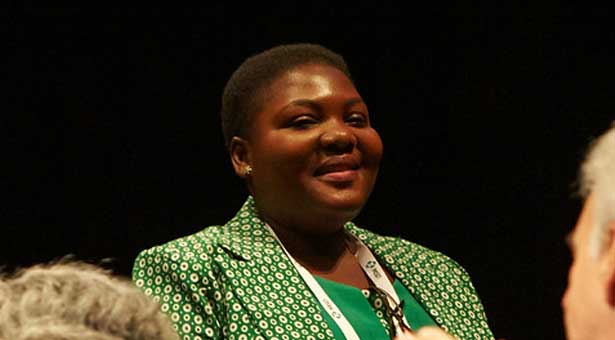
Of course, many girls all over the world are trafficked, women do turn to sex work out of desperation and they are victimized by it. But Daisy Nakato Namakula helped shift my black-and-white point of view. She looks like a high school guidance counselor or customer-service rep at a bank. Even her name suggests “lady next door.” But Namakula is a 32-year-old Ugandan sex worker and sex-work activist. She addressed a room of hundreds of AIDS conference delegates, stressing, “I am very happy to be a sex worker and happy to speak for myself.”
Namakula contracted HIV in 2000 at age 18 and nearly died. In Africa about 40 percent of sex workers are HIV positive. Medication saved her, and sex work, Namakula said, has allowed her to thrive. She recently earned a college degree in social work, and I was surprised that she uses her education not as a path out of sex work but to enhance her activism in the Women’s Organisation Network for Human Rights Advocacy (WONETHA), a sex worker group she co-founded. Among other services, the group promotes safer sex practices.
“My clients used to call, and I would say, ‘Why are you calling? I’m in class, I’m on campus,’” she said, laughing.
Like other advocates, Namakula says that criminalizing sex work exacerbates HIV. Experts believe that punitive laws associated with sex work prevent sex workers from reporting violence and abuse and keep them from accessing health services, including HIV treatment and prevention.
Namakula adds that stigma and discrimination harm sex workers. For example, even low-level assumptions that all women and men in the profession are victims disempower sex workers and can lead to “forced rehabilitation.” WONETHA’s slogan: “Sex workers need rights, not rescue.”
“These programs that think buying a sewing machine for a sex worker will get her off the street and fight HIV get a lot of money,” she said. “I can afford a thousand sewing machines, but why would you think that buying a sewing machine will help this world to fight HIV?”
Next week, in “HIV Does Discriminate: The Worldwide Fight Against Stigma and Discrimination, Part 3,” learn about the issues facing men who have sex with men.
Linda Villarosa has covered HIV/AIDS since the early days of the epidemic and has attended the International AIDS Conference six times. She traveled to Melbourne as a volunteer reporter for Black AIDS Daily with her daughter, Kali.
