By Dara Kam
©2023 The News Service of Florida.
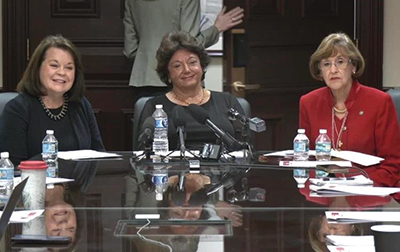
TALLAHASSEE — Florida Senate President Kathleen Passidomo and two key lieutenants on Thursday rolled out a plan aimed at expanding access to health care, with a focus on increasing the number of doctors, encouraging technological innovation and boosting medical screenings.
The legislative package calls for spending nearly $900 million to, among other things, shift patients away from emergency rooms, offset hospitals’ training costs and help doctors pay off debt.
Speaking to reporters, Passidomo called the plan a “very, very robust” package with “very creative concepts that will help address the workforce needs” as the state’s population continues to grow.
“As you know, about 1,000 people a day move to the state of Florida, many of them are older. Everybody needs health care. In Florida today, we do not have enough health-care personnel to take care of the Floridians that are living here,” Passidomo, R-Naples, said. “And so our whole goal is, how do we grow our health-care system in Florida, our workforce, and that’s how we started.”
Detailed bills will be filed Friday, and the Senate Health Policy Committee will take up the proposals next week, Passidomo said.
The effort to boost access to health care comes as more than 11 percent of Floridians lack insurance, according to the U.S. Census Bureau. Only four states had higher uninsured rates than Florida in 2022, according to a September report. The rates reflect insurance provided in employer-based plans and purchased privately, along with coverage through government programs such as Medicaid and Medicare.
Democrats have long called for expanding Medicaid eligibility, but Republicans have rejected the idea — with Passidomo reiterating her opposition Thursday.
“That’s just a talking point. Everybody’s gonna get seen. “We just want to make sure they get the quality — efficient, effective, and economical,” Passidomo said. “That’s just a talking point right now. Medicaid expansion doesn’t work, and we’re gonna take care of everybody. … We’re already paying for a lot.”
House Minority Leader Fentrice Driskell, D-Tampa, called the Senate plan disappointing.
“Every Floridian deserves the freedom to be healthy, prosperous and safe, and that certainly includes the ability to have access to high-quality, affordable health care,” Driskell told reporters. “And in Florida, that necessarily means Medicaid expansion. For our Republican colleagues to refer to it as simply ‘a talking point that wouldn’t do anything’ is utterly unserious.”
Driskell said Florida is among only 10 states that did not expand Medicaid under the federal Affordable Care Act. The state could draw down $4 billion in federal money through expansion of the joint state and federal program for low-income people, Driskell said.
The Senate’s “Live Healthy” plan, however, would expand lower-income Floridians’ access to free and charitable clinics by raising an income-eligibility threshold.
The Senate’s proposal also seeks to expand or create programs to divert people from emergency rooms and get more people screened for medical conditions such as heart disease and diabetes.
As an example, the plan would require hospitals to help patients “access appropriate care settings” in non-emergencies and to encourage patients to establish a “medical home” to prevent future emergency room visits for non-emergency situations. Hospitals, for example, could direct patients to urgent-care facilities or primary-care practices nearby.
“A big goal of ours is so that every Floridian has a medical home, has a primary-care physician who they can go to the next time they have a fever, instead of walking through the doors of an emergency department where we know a lot of people just aren’t comfortable anyways, but they don’t think they have any other option or they can’t get an appointment with a doctor so they walk into an emergency department,” said Senate Health Policy Chairwoman Colleen Burton, a Lakeland Republican who took part in Thursday’s rollout.
The plan also would require the Agency for Health Care Administration to seek federal approval of a program called “Hospital at Home,” which would allow Medicaid beneficiaries to receive hospital care at home. Also, the plan seeks to increase access to mental-health care, in part, by expanding mobile-response teams to reduce people being subject to the Baker Act, which can involve involuntary admissions to facilities.
The legislation also addresses “maternity care deserts” in rural areas. The proposal would create an “advanced birth center” designation allowing certain birth centers to perform low-risk deliveries, including caesarian sections, and would reduce regulations for autonomous nurse midwives.
The proposal would seek to boost the health-care workforce by taking steps such as:
— Making it easier for foreign-trained physicians to practice in Florida.
— Expanding loan-repayment assistance for doctors and dentists who remain in the state after graduating. Recipients of the assistance would have to commit to serving Medicaid patients and providing volunteer services.
— Creating a new, limited license for medical school graduates who have passed their exams but have not begun residency programs.
The Senate also wants to bolster the state’s Graduate Medical Education program by creating 700 new residency openings through increased funding for what’s known as Florida’s Slots for Doctors Program.
Passidomo told The News Service of Florida that the state needs more slots in residency programs and that she would like to see “Florida-trained” physicians take more openings.
“We have more students graduating from medical schools in Florida than we have residency slots. That makes no sense. So, then they have to leave the state. The minute they leave the state, they meet somebody, they get married, and then they don’t come back,” Passidomo said.
The Legislature’s Office of Program Policy Analysis and Government Accountability has issued a series of recommendations on retaining graduating doctors, including providing incentives to Florida medical schools to give priority to in-state students when matching graduates to health-care facilities.
The Senate proposal also would create a “Health Care Innovation Council” to help oversee a proposed low-interest loan program designed to “incentivize innovation,” Senate Health and Human Services Appropriations Chairwoman Gayle Harrell, R-Stuart, told reporters during Thursday’s rollout.
The Senate wants to spend $75 million annually on the program — which Passidomo said would be the first in the nation — over the next decade. Interest rates would be no higher than 1 percent, Harrell said.
“I think this is the most creative, innovative way to use our whole system to put that patient at the center of health care, using new ideas, creative things, and changing our Florida’s health-care system,” she said.