
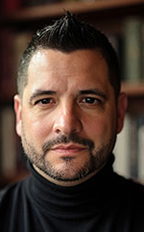
By George Cassidy Payne
There are two scenes I cannot shake, and I need to be honest about why.
The first unfolds in the Oval Office, that carefully staged room where power is both exercised and performed. Donald Trump asks an aide to hand him a model bomber. He turns it over in his hands, smiling, admiring it, and then — almost tenderly — he hugs it.
“Give me that bomber… let me just hug that little sucker.”
I watched that clip, and something in me recoiled — not just at the moment itself, but at how easily it could pass as normal. How quickly the machinery of war can be made small, even affectionate.
Because I know what that machine is.
The real aircraft behind that gesture — the Northrop B-2 Spirit — was designed to move through the sky without being seen. Built by Northrop Grumman with partners like Boeing, it exists to penetrate defenses, to arrive without warning, to deliver payloads that can level entire structures in seconds. It can carry dozens of precision-guided bombs. It can carry nuclear weapons. It is engineering in the service of disappearance — disappearance of sound, of visibility, of warning.
And maybe most dangerously, disappearance of consequence.
The second scene is one I can’t stop imagining.
A young girl in Tehran is crying for her mother.
I don’t know her name. That’s part of what haunts me. I don’t know what her voice sounds like, what her favorite game is, what her mother used to say to calm her down at night. I only know that somewhere beneath broken concrete and dust, her mother is gone, killed in an airstrike, and that whatever the last hug between them was, it has already happened.
When I think about that clip from the Oval Office, I don’t stay in that room for long. My mind goes somewhere else entirely.
It goes to her.
It also goes, just as quickly, to the families of American service members. Because grief doesn’t recognize borders, and loss doesn’t check passports.
According to reporting by USA Today, the number of American troops injured in this war has climbed to 200. Ten are seriously wounded. More than 180 have already returned to duty — returned, as if nothing essential has been altered.
Thirteen are dead.
I find myself reading their names slowly, not as information but as interruption:
Maj. John A. Klinner. Capt. Ariana G. Savino. Tech. Sgt. Ashley B. Pruitt.
Capt. Seth R. Koval. Capt. Curtis J. Angst. Tech. Sgt. Tyler H. Simmons.
Capt. Cody A. Khork. Sgt. 1st Class Noah L. Tietjens. Sgt. 1st Class Nicole M. Amor. Sgt. Declan J. Coady. Maj. Jeffrey O’Brien. Chief Warrant Officer 3 Robert Marzan. Sgt. Benjamin Pennington.
I think about who spoke their names last. I think about the last time they hugged someone goodbye without knowing it would be the last time.
And I think about the children, because there are always children, who will grow up with that absence shaping everything.
When I put these images together, I can’t keep the usual distance that commentary seems to require. I don’t experience this war as strategy or policy first. I experience it as a series of human ruptures that keep multiplying.
A man in power holding a model of a bomber like something precious.
A child reaching for a mother who will never hold her again.
Families here, in places like Ohio or Kentucky or Florida, trying to make sense of a knock on the door that changes everything.
We are told that around 2,000 people have been killed across the region. More than 1,300 in Iran alone. The numbers rise, they are updated, they are absorbed into the rhythm of the news cycle.
But I can’t relate to the numbers.
I relate to the hug.
To the presence of it. To the absence of it.
War depends on a kind of distance that I don’t seem able to maintain anymore. Not emotional distance, not moral distance. Once you really let yourself imagine the moment after impact, the dust, the silence, the voice calling out, it becomes impossible to return to abstraction.
It becomes impossible to look at a bomber, even a small one, and not see what it does.
So, I keep coming back to those two scenes, even when I’d rather not.
A president hugging a machine built to erase.
A child calling out into the space where her mother used to be.
And somewhere between them, all of us, deciding — quietly, daily — what we are willing to see, and what we are willing to hold.
George Cassidy Payne, syndicated by PeaceVoice, is a Rochester-based writer whose work sits at the intersection of politics, ethics, and lived experience. A poet, philosopher, and 988 crisis counselor, he covers issues of democracy, justice, and community resilience.
