 The Mizells: A medical history
By Tom Swick, FLMag.com
In 1910 Isadore and Minnie Mizell had come down from Jasper, Fla., to Dania Beach, where they farmed tomatoes and raised 14 children. The four oldest were sent off to St. Augustine to attend Florida Normal and Industrial Institute.
“In South Florida at that time, Blacks couldn’t go to school full-time,” Mizell explains. “They had to work in the fields.”
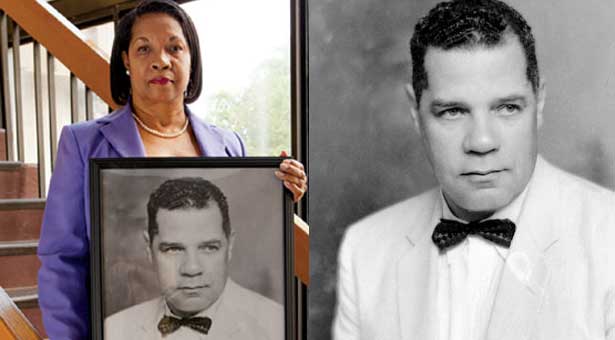
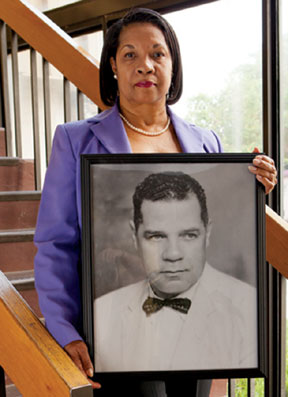
The oldest child, Von, went on to study at Morehouse College in Atlanta and then Me-harry Medical College in Nashville, the first medical school in the South for African Americans. He returned to South Florida in 1937 and set up a medical practice in Fort Lauderdale, starting on Fifth Street and later moving to Sixth.
“My grandfather was a work-aholic,” Deborah Mizell says, “an excellent provider for his family. He was a farmer, as well as a carpenter. He also,” she adds chuckling, “pulled people’s teeth.”
That December a Black man who had been shot was turned away from both Broward General Hospital and Memorial Hospital. Dr. Mizell “pushed and pushed and they finally let him operate,” his daughter says of the staff at Memorial, “but they said that after the operation the patient would have to leave.” A few months later, Dr. Mizell and Dr. James Sistrunk opened Provident Hospital, the first hospital for Blacks in Broward County. There was symmetry in Dr. Mizell’s co-founding the facility as his father, Isadore, built the county’s first school for Blacks.
Dr. Mizell continued his practice. “He was Broward’s first Black surgeon,” Mizell says, “but he did it all,” including house calls. “Often people would give him a plate of food, or a piece of cake, because they had no money.”
After her mother’s death at the age of 27, Deborah Mizell was raised by an aunt in Rich-mond Heights.
“He was not perfect,” she says of her father, “but he tried to do what was right.” He was one of the founders of the Fort Lauderdale chapter of the NAACP. “I would like him to be remembered as a campaigner not for himself, but for the underserved and undervalued.”
With the advent of integration in the ’60s, Provident Hospital closed, and Dr. Mizell was granted privileges to work at Broward General. “That was a huge, ugly legal battle,” Mizell recalls. “They let him operate because his patients wanted him. But they didn’t like having a Black surgeon in the hospital. So to get rid of him they said that he was doing unnecessary surgeries. My father sued and won, and got his privileges back.”
Life wasn’t easy for his children either. Mizell remembers a visit to her maternal grandmother, who owned Lewis Café on what is today Sistrunk Boulevard. Her aunt came running into the house, wrapped her in a blanket and swooped her up into her arms. The Ku Klux Klan was outside, saying they were coming to kill a Mizell. Getting spirited away, Deborah, like any curious child, pulled the blanket down from over her eyes so she could see and what she glimpsed was a burning cross. “I think of that,” she says, “every time I pass the site on Sistrunk.”
In 1961, on the Fourth of July, Dr. Mizell, along with civil rights leader Eula Johnson, led a group of African Americans in a “wade in” at the “whites only” beach near Las Olas Boulevard. “They walked through a group of police officers and got into the water,” the daughter recalls. “They were in there for about 30 to 45 minutes before they were told to leave. My daddy said to me: ‘I had to prove to them that the water wasn’t going to turn Black.’”
Whenever she visited Fort Lauderdale, her father had her work in the clinic. “He was determined to make me a doctor. So on Saturday when everybody else was out playing, I was taking patients’ temperatures.”
But in this, at least, the surgeon did not quite succeed. “I had a lot of his personality,” she says, smiling, “being stubborn.” She had seen how work consumed his life, and that seemed incompatible with her desires to raise a family. She studied nursing and became an RN. Today she has three children – Johnny C. Taylor Jr., Jacqueline Taylor and Dawna Taylor-Thornton and three grandchildren.
Her father took his first vacation in 1971, traveling to Europe. Two years later, while performing an operation at Broward General, he passed out. He was flown to Boston, where efforts to save him were un-successful. “Daddy took care of everyone else,” Mizell says. “He did not take care of himself.” He was dead from cancer at age 63.
His funeral was held at First Baptist Piney Grove Church, where his brother Ivory was assistant minister. “There were dignitaries from all over,” Mizell recalls. “It was literally a packed church.”
Ivory was well-known in town as a photographer as well as a minister. He was also instrumental in starting the first library for Black children. Somewhat more spectacularly, he staged his own “pre-funeral.” Mizell still has a picture of her uncle dressed in his white robe. “He looked very ghostly. He said that anybody who had anything to say about him should say it. He didn’t want it said after his death.”
Her favorite uncle, Roy, owned Mizell Funeral Home and helped establish the Fort Lauderdale Negro Chamber of Commerce.
Mizell still works; lately she has been educating African American and Caribbean communities about hospice care. She has also been busy, along with her cousin Don, a prominent attorney, keeping the Mizell legacy alive. Two of their projects are trying to get the name of John U. Lloyd Beach State Park changed to Von D. Mizell State Park (or Mizell-Johnson State Park) and trying to get a historical marker placed on the old site of Provident Hospital.
“That’s sacred ground,” she says of the land where the hospital stood, now occupied by the Von D. Mizell Community Center. “It hasn’t been given the justice – the honor – it deserves.”